Download
1 / 23
240 likes | 375 Vues
The Byzantine Empire flourished as the Eastern Roman Empire after the West's collapse in the 5th century. Under Emperor Justinian (527-565), it saw a remarkable revival in politics, law, and culture. Justinian's reforms, including the famous Justinian Code, shaped Byzantine law and society. His ambitious building projects, most notably the Hagia Sophia, symbolized the empire’s power. The empire's military might, economic prosperity, and unique character led to its lasting legacy, though tensions with the Western Church ultimately contributed to its decline, culminating in the fall of Constantinople in 1453.

E N D
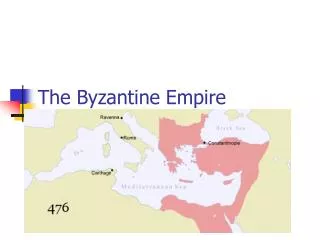
I. A New Rome • Western Roman Emp. crumbled in 5th cent. • Capital of East = Byzantium
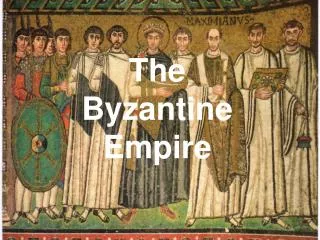
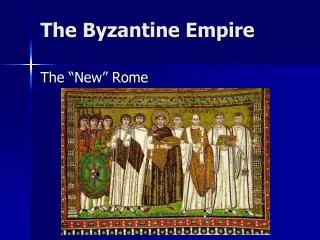
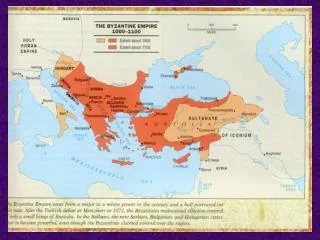
A. The Reign of Justinian • East = Greece, N. Balkan Pen., Asia Minor, Syria, Palestine, Egypt, Cyrenaica • Emperor Justinian (r. 527-565) • Led political, economic, intellectual, & artistic revival
1. Theodora • 525: married Justinian • Helped change Byz. law regarding women • Domestic violence • Owning property • Widow & custody • Nika Revolt (532)
2. Belisarius • Commander-in-chief of army • Regained former Roman territories in Med. • Byz. reached its greatest height • 533: recovered N. Africa • 535: attacked & seized Rome (Ostrogoths)
Byz. Emperors = absolute power • headed state & church • threat of assassination
II. Life in New Rome • Byz. Emp. developed its own character • Roman ties?
A. Justinian Code • Panel of legal experts reviewed 400 yrs. of Roman law (outdated & contradictory) • 1. the “Code” = 5,000 Roman laws (useful) • 2. the “Digest” = summarized opinions of great Roman thinkers • 3. the “Institutes” = textbook for law students • 4. the “Novellae” = (New Laws), presented legislation after 534
Decided legal questions regarding marriage, slavery, property, inheritance, women’s rights, & criminal justice • 565: Justinian died, but code survived
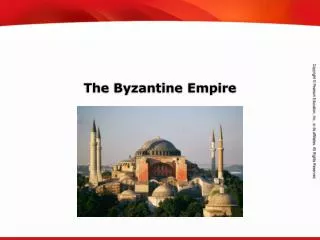
B. Creating the Imperial Capital • Ambitious building programs • Rebuilt fortifications of Const. • Church building (connection betw. church & state) • Hagia Sophia (“Holy Wisdom”) • “the most splendid church in the Christian world” • Completed in 537 • “Solomon, I have outdone thee!” • Enlarged palace • Also, baths, aqueducts, courts, schools, hospitals
Greco-Roman culture preserved • Education focused on Greek & Roman lit.
III. Strengths of the Empire • Political, military, economic strength
A. Political Strength • Centralized govt. • Skilled, efficient, well-paid officials • Practiced shrewd diplomacy
B. Military Strength • Frontier forces, infantry, cavalry • Rewarded soldiers w/land grants • 590: instruction manuals for officers on military strategy • Improved army weaponry • 500s: built navy • “Greek fire”
C. Economic Strength • Prosperous ag., manufacturing, & trade • Const. = heart of emp. • Strategic location on Bosporus betw. Asia & Europe • Govt. = regulated trade & manufacturing
IV. The Church Divides • Christianity developed differently betw. West & East
A. A Religious Split • Patriarch (Rome, Const., Alexandria, Antioch, & Jerusalem) • Pope (patriarch of Rome) = supreme authority in West (Byz. did not recognize) • Debate over icons (holy pics = Jesus, Virgin Mary, & the saints)
Byz. = iconoclasts (icons constituted idol worship & should be suppressed) • 726: Emp. Leo III—outlawed icon worship in East • West = pope of Rome summoned a council in 787 • Opposition to icons = heresy
Council threatened iconoclasts w/ excommunication • Friction betw. Pope (Rome) & patriarch (Const.) • Combined w/cultural & language diffs. • 1054: Church split • West = Roman Catholic Church • East = Eastern Orthodox Church
V. Decline of the Empire • 1300s: Ottoman Turks rose to power • 1453: captured Const. (Byz. Ended)