PERIODICALS:
120 likes | 241 Vues
Discover the world of periodicals, which are publications released regularly over time, including newspapers, magazines, and scholarly journals. This guide provides insights into searching for periodical articles effectively, highlighting the importance of databases, controlled vocabulary, and keyword searches. Learn how to navigate various formats—print, electronic, and online—and utilize Boolean operators to refine your search outcomes. With practical tips on identifying peer-reviewed journals and leveraging libraries’ resources, this guide equips you to enhance your research strategies.


PERIODICALS:
E N D
Presentation Transcript
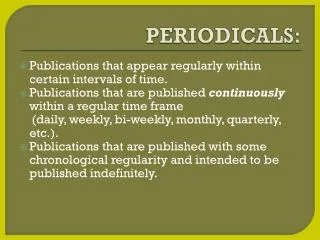
PERIODICALS: • Publications that appear regularly within certain intervals of time. • Publications that are published continuously within a regular time frame (daily, weekly, bi-weekly, monthly, quarterly, etc.). • Publications that are published with some chronological regularity and intended to be published indefinitely.
PERIODICALS can be: • Popular (newspapers, magazines, newsletters) • Trade/professional (published by organizations) • Scholarly (journals published by universities, colleges, scholarly societies, etc.)
PERIODICALS can appearin various formats: • Print • Microform Ex: microfilm, microfiche • Electronic format Ex. CD-ROM or other standalone computer application such as SciFinder Scholar) • Online (available via the WWW)
HOW TO SEARCH FOR PERIODICAL ARTICLES • DATABASES & INDEXES should become your best friends. • Databases available via UAlbany Libraries are listed either: • by subject OR • alphabetically
CONTROLLED VOCABULARY VS. KEYWORD SEARCH CONTROLLED VOCABULARY: • Library of Congress SUBJECT HEADINGS • National Library of Medicine SUBJECT HEADINGS • Descriptors assigned by indexers • Thesauri assigned by indexers Ex. Art and Architecture Thesaurus KEYWORD SEARCH: • Any possible word that seems appropriate for a particular topic • KWIC (keyword within the context) and KWOC (keyword outside the context)
CONTROLLED VOCABULARY ADVANTAGES: • You get better search results (more precise, smaller number of returned entries saves you time). DISADVANTAGES: • You have to find controlled vocabulary terms first. • It’s inflexible – once a term is assigned, you have to follow it
KEYWORD SEARCH ADVANTAGES: • You use words from your natural language. • You don’t have to come to the library and search LIBRARY OF CONGRESS SUBJECT HEADINGS (LCSH). DISADVANTAGES: • The number of results returned is often overwhelming. • The relevance of the results is quite low (the computer searches for every possible use of your keyword).
HOW DATABASES WORK Each database has a slightly different set of rules Usually they use Boolean operators AND, OR, and NOT Truncation operators (also Wildcard characters): you can shorten the word and it will look for similar words with the same roots (diseas* will bring “disease” and “diseases”) Proximity operators will search for terms within several words from each other in a phrase.
IMPORTANT !!! Read about every particular database you’re about to search. Do not use too many search terms while performing a Boolean search (two-three is usually enough). Once you find a good article, check descriptors (or subject headings) from the full record to get similar controlled vocabulary terms for subsequent searches.
USEFUL TIPS: • When looking for scholarly journals, check delimiter “peer-reviewed” (in some publications it’s called “refereed”). • If in doubt go to Databases & Indexes and select Ulrich’s International Periodical Directory. It has all necessary information about your periodical (place of publication, initial dates of publication, subjects covered, etc.) VERY USEFUL!