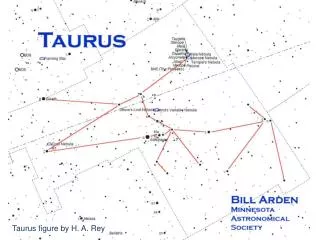
Taurus figure by H. A. Rey
410 likes | 597 Vues
Taurus figure by H. A. Rey. Or, if you prefer, …. Taurus. 17 th in size of the 88 constellations 797 sq. degrees 1.9% of the Celestial Sphere When you look at Taurus, you’re looking away from the center of the Milky Way and slightly down, below the plane of the galaxy


Taurus figure by H. A. Rey
E N D
Presentation Transcript
Taurus • 17th in size of the 88 constellations • 797 sq. degrees • 1.9% of the Celestial Sphere • When you look at Taurus, you’re looking away from the center of the Milky Way and slightly down, below the plane of the galaxy • galactic coordinates of Aldebaran: 181 °, -20° • Culminates on Dec. 3 (Aldebaran) • In about 2450 BC, at the Vernal Equinox
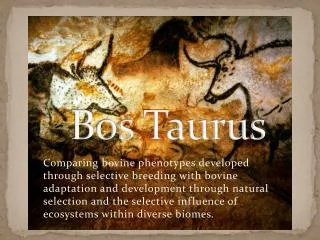
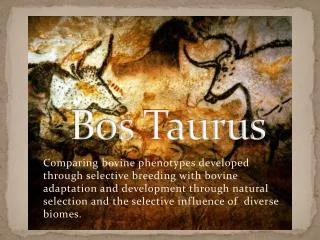
History • One of the oldest known constellations • Probably ancient when Ptolemy listed the 48 • Cave paintings at Lascaux (21,000 BP) – is this Taurus & the Pleiades?
Mythology • Disguise used by Zeus to woo Europa (“for the usual discreditable purposes”) • In the Zodiac, the Cretan Bull – one of the Twelve Labors of Herakles • Bull was dedicated to Bacchus, the Wine God – Hyades are dancing girls at his festival • The Pleiades have their own mythologies, in many different cultures – we’ll talk about that later
Overview Pleiades (M 45) 370 ly Elnath (. beta) 1.7 131 ly Hyades 153 ly Aldebaran 0.9 65 ly Red G , zeta 3.0 415 ly
Name this author … “What caused me to undertake the catalog was the nebula I discovered above the southern horn of Taurus on September 12, 1758, while observing the comet of that year…. This nebula had such a resemblance to a comet, in its form and brightness, that I endeavored to find others, so that astronomers would not confuse these same nebulae with comets just beginning to shine….”
So he began with M1 X-ray (CHANDRA) Visible (Palomar) IR (2MASS) Radio (NRAO)
M1 – a SNR • Supernova first observed by Chinese astronomers on July 4, 1054 (some fireworks!) near zeta Tauri • Type II Supernova remnant • Strong H lines in spectrum • 1046 J of energy released – 100X much energy as the Sun has emitted in its entire history • “After more than a year, it gradually became invisible” • 6,000 ly away • At center is a pulsar, a neutron star spinning at 30 times per second
Observing M1 • Magnitude 8.4, 6.0’ x 4.0’ • Challenge object in AL Binocular Messier Club for 35 & 50 mm binoculars • It’s close enough to us (about 6500 ly) that its continuing expansion is actually visible over time – about 0.2” per year (about 600 mi/sec)
Major Stars • Aldebaran - the Follower (of the Pleiades) • Magnitude 0.9 • 65 ly • Luminosity 360 Ls • Diameter 45 Rs • Red G star • Elnath (beta Tauri) – the Butting One • Magnitude 1.7 • 131 ly • Luminosity 600 Ls
Double Stars • Chi Tauri: 5.4 & 7.6, separation 19.6” • 118 Tauri: 5.5 & 6.8, separation 4.7” Tau 118 Tau
Open Clusters • NGC 1647: 6.2, 1800 ly • NGC 1746: 6.1, 1400 ly NCG 1746 NGC 1647
Nebulosities • Crystal Ball Nebula • NGC 1514, 10.9 • Hind’s Variable Nebula • NGC 1555, 1.5’ • Burnham’s Nebula, • No NGC, ?? • Struve’s Lost Nebula • NGC 1554, ?? • The last three are all around T Tauri (later!)
Variable Stars Sky Tools 3 lists 133 variable stars brighter than magnitude 12.0, 44 brighter than magnitude 6.0 Have fun!
T Tauri • The archetype of an important class of variable star • Only magnitude 13.5
T Tauri Stars • Very young stars (protostars) – still contracting, not yet on Main Sequence • Emission lines as well as absorption lines in their spectra – so surrounded by thin, hot gas • Eject 10-7 to 10-8 Ms of gas per year at speeds of about 180,000 mph • Luminosity changes irregularly on scales of a few days • Masses < about 3 Ms and ages 1 million years. • The Trapezium stars in Orion began this way
Finding T Tauri 1 eyepiece FOV
Finding T Tauri 1 eyepiece FOV
And for you imagers … • Sharpless 2-240 (Simeis 147)
The Pleiades • M 45 is so well-known it doesn’t need much explanation • You can find them on any clear night when it’s above the horizon, even in the city • So I’ll concentrate on the mythology and the astrophysics • Besides – they’re worth an evening by themselves!
Myths & Stories • Greek / Roman • Sometimes seen as a bunch of grapes. As they set in the west, Orion seems to be leaning forward (dangerously) in an attempt to pick them. Maybe he’s already had too much to drink? • Seven sisters, daughters of Atlas & Pleione • Alcyone (the most beautiful & brightest), Celaeno, Maja, Merope, Taygete, Sterope, Electra • When Orion once attempted to break into their home, Venus changed them into a flock of doves
Myths & Stories • Native American • Seven children who longed to wander amidst the stars. They lost their way. They huddle together to make sure they won’t be separated. The youngest cries from homesickness; she’s the dimmest of the seven. • Devil’s Tower (Wyoming) was created to protect seven maidens pursued by bears • Medieval European people saw them as a hen & chicks (England, Germany, Denmark, Russia) • Midnight culmination (Nov. 21) was identified with the Witches’ Sabbath
Myths & Stories • South Seas islanders (Society & Tonga group, Hervey group) • Matariki was a single star, so bright that the god Tane, in envy, took Aumea (our Aldebaran) and, along with Mere (our Sirius), chased Matariki, who took refuge in a stream. Mere drained all the water out of the stream and Tane hurled Aumea at Matariki, breaking him up into smaller pieces. • Tolkein named them Remmirath in The Hobbit
The Pleiades • At least 500 stars in the overall cluster • Nebulosity is bluish, indicating it’s a reflection nebula • No relative proper motion, so likely to be loosely bound by gravity • Will probably disperse over the next 200 My • 440 ly away • About 100 My old • A young cluster of hot, bright stars