Presentation and Evaluation of Historical Occupational Stratification Scale: HIS-CAM Insights
This presentation from the HIS-CAM workshop at Leuven in November 2007 explores the development and evaluation of a historical occupational stratification scale based on social interaction analysis. It discusses comparative historical research methods, focusing on the CAMSIS approach to social stratification. Key topics include the derivation of scales for various countries, gender, and time periods, as well as empirical methodologies used in scaling occupations. The study highlights the importance of social interaction data in understanding occupational hierarchies and their significance in historical research.

Presentation and Evaluation of Historical Occupational Stratification Scale: HIS-CAM Insights
E N D
Presentation Transcript
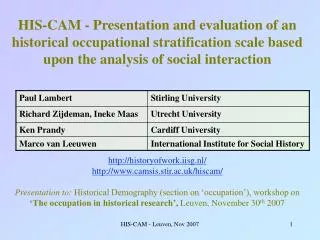
HIS-CAM - Presentation and evaluation of an historical occupational stratification scale based upon the analysis of social interactionhttp://historyofwork.iisg.nl/http://www.camsis.stir.ac.uk/hiscam/Presentation to: Historical Demography (section on ‘occupation’), workshop on ‘The occupation in historical research’, Leuven, November 30th 2007 HIS-CAM - Leuven, Nov 2007
Occupations and social structure • ‘Starting from the occupational titles themselves’ [HISCO – van Leeuwen, Maas & Miles 2002] • Comparative historical research This talk: • HIS-CAM and the ‘CAMSIS’ approach • Approaches to ‘universality’ and ‘specificity’ HIS-CAM - Leuven, Nov 2007
CAMSIS (www.camsis.stir.ac.uk) Social Interaction Social Stratification Index of occupation’s positions • Social interaction data (occupations of associates) • Partnership – Readily available in contemporary countries • Friendship; Intra-generational mobility; Inter-generational mobility; ... • ‘Specific’ approach • Many scales - for countries, gender, time periods, using detailed occ. codes CAMSIS – ‘Cambridge Social Interaction & Stratification Scales’ • Stewart, A., Prandy, K. and Blackburn, R.M. (1980) Social Stratification and Occupations. MacMillan. Other related applications: • Laumann, E. O., & Guttman, L. (1966). The relative associational contiguity of occupations in an urban setting. American Sociological Review, 31, 169-178. • Chan, T. W., & Goldthorpe, J. H. (2007). Class and Status: The Conceptual Distinction and its Empirical Relevance. American Sociological Review, 72, 512-532. HIS-CAM - Leuven, Nov 2007
CAMSIS scale derivationswww.camsis.stir.ac.uk • Work on 27 countries so far, full derivations for 14 • Australia 1996; Slovakia 1995; Austria 1991/5; Slovenia ; Britain 2001, 1991, 1971, C19th; Spain 2002; Sweden 1990; Czech 1994; Switzerland 1990; Germany 1991/5; Turkey 1990; Hungary 1990/6; USA 1960, 1990, 2000; Ireland 1996 • ISCO and national occupational unit schemes • Downloaded as zip archives with ‘index file’ matching • Further national derivations actively pursued • Empirical perspective – scales ‘neutrally’ derived HIS-CAM - Leuven, Nov 2007
CAMSIS scale construction methods • We use Goodman’s RC-II Association models in lEM (Vermunt 1997); correspondence analysis also suitable • RC-II allows us to separate out other influences on social interaction in occupations through ‘pseudo-diagonals’ and ‘subsidiary dimensions’
CAMSIS for historical comparative research? • Preserve detailed occupational differences • Typically 300+ different scores in a dimension of stratification • Easy to add employment status dimension(s) if required • Comparative properties • Tell us about relative positions of occupations within their contexts {national / temporal / gendered / other} • Inter-generational occupational links • Data on social interaction between occupations • marriage records for husband-wife and their parents • household census returns (within-household occups) HIS-CAM - Leuven, Nov 2007
HIS-CAM in short • Version 0.1(www.camsis.stir.ac.uk/hiscam/, May 2006) • Netherlands, Germany, France, Sweden, UK, Canada • Small range of scales linked to HISCO units & sub-groups • One cross-national scale (universal), and 6 national scales (specific), for 1800-1938 • Version 0.2(in process) • Improved micro-data on 6 core countries (extended coding quality review; increased volume of cases) • Consideration of US micro-data from IPUMS • A larger range of universal and specific scales, using different permutations of countries, time periods, and gender HIS-CAM - Leuven, Nov 2007
HIS-CAM scales prove to have very similar properties to contemporary CAMSIS scales • Clearly reflect an order of stratification advantage / disadvantage in occupations • Jobs with educational requirements tend to be highest ranked (Univ. professors) • Low skilled labouring jobs tend to be lowest ranked • Correlate around 0.7 with prestige scales, class schemes • Some plausible differences between different specific scales • Agricultural jobs show most variation in relative positions between countries • Service sector jobs change positions over period HIS-CAM - Leuven, Nov 2007
HIS-CAM at length • We have numerous possible specific scales • How do we decide between them.. => 2) Approaches to Universality and Specificity in historical data HIS-CAM - Leuven, Nov 2007
Previous paper (May 2006) • It is easy to justify attention to specificity • Statistically, specificity makes for a better model • Substantively, specific differences often make sense HIS-CAM - Leuven, Nov 2007
Nested scale estimates using lEM (Vermunt 1997) HIS-CAM - Leuven, Nov 2007
v0.2: There are problems with specificity • It’s a great deal of work to produce specific scales… • Users don’t want measures which are too complex • There are possible measurement errors • Coding practices varying by countries • Model estimates rely on data management / adaptations HIS-CAM - Leuven, Nov 2007
Permutations and Occupations HIS-CAM - Leuven, Nov 2007
Data used in v0.2 HIS-CAM - Leuven, Nov 2007
The impact of data • Distribution of cases into occupations on each of the 900 samples is substantially different • (in v0.1, this was ignored by using common coding in a nested model framework) • Ideally, a principle of specificity would involve national experts in occupational coding and statistical modelling, iteratively reviewing coding and categorisations whilst optimising statistical models [=>relatively few contemporary CAMSIS scales…] • In practice… HIS-CAM - Leuven, Nov 2007
v0.2 strategies • Automated recoding of sparse occupations • (to popular or generic subgroup codes) • Standard model selection criteria • (2 dim model, excluding diagonals) • Est. 2 hrs data management and 1 hour scale estimation processing time per scale HIS-CAM - Leuven, Nov 2007
Example results so far… HIS-CAM - Leuven, Nov 2007
Current conclusions • Country patterns influence pooled patterns (e.g. Dutch structure dominates pooled models) • Argues for specificity within countries • May be better to use national scales internationally, than derive pooled scales • Universality / specificity is largely about practical concerns HIS-CAM - Leuven, Nov 2007
Conclusions – HIS-CAM and other Occupation-based social classifications • HIS-CAM is an effective measure of stratification inequality • ‘Concepts and measures’ debate in social classifications… • HIS-CAM a fruitful approach for examining particular occupational circumstances within countries • HIS-CAM is potentially sensitive to structural differences in occupational distributions between contexts • Challenges of working with and communicating large volumes of occupational information.. HIS-CAM - Leuven, Nov 2007