Understanding Screen Printing: History, Technique, and Modern Applications
Screen printing is a popular method for applying ink onto various surfaces, commonly used to print images on T-shirts and other fabrics. This technique involves applying ink through a fine mesh screen, with a separate screen prepared for each color being printed. Originating from early Polynesian methods, screen printing was introduced to Western Europe in the 1700s. Today, it is widely utilized in both fine arts and commercial printing, allowing for vibrant designs on textiles, CDs, glass, paper, metals, and wood.


Understanding Screen Printing: History, Technique, and Modern Applications
E N D
Presentation Transcript
Screen Printing By: Shelby lee Sheppard
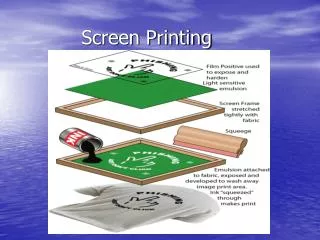
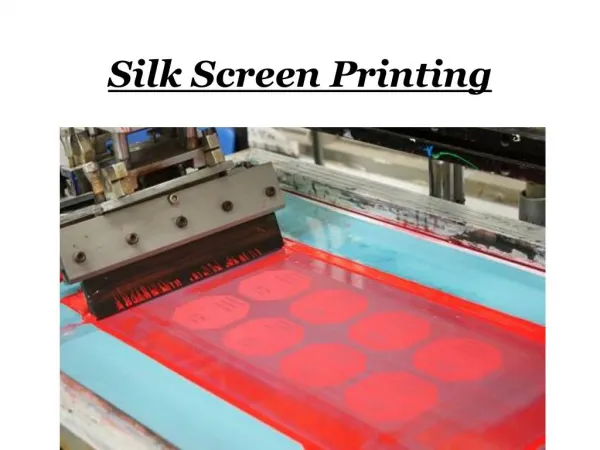
What is it? • Screen printing is what is done to print a picture on t shits or other fabric. To do this ink is applied to the surface to be printed. The image is then put on a very fine fabric which would be called the screen. The ink is wiped across the screen. For each color to be printed a separate screen is prepared.
Origin • By cutting shapes into banana leaves and pressing dye into the cut-out portions, early Polynesian Island natives were able to produce some of the first screen prints. • In the 1700 screen printing was introduced to Western Europe from Asia in the. But did not gain use in Europe until silk mesh was more available for trade from the east. • Screen Printing was originally used as a popular method to print expensive wall paper, printed on linen, silk, and other fine fabrics.
Today’s Use • Screen printing currently used for both in fine arts and in commercial printing, where it is commonly used to print images on graphic T-shirts, hats, CDs, DVDs, glass, paper, metals, and wood and even mugs.