Download
1 / 3
30 likes | 151 Vues
In this lesson on congruent triangles, we dive into various congruence statements that can be derived from given segments SL, SR, and angles ∠1 and ∠2. Utilizing the Reflexive Property of Congruence, we demonstrate how to establish relationships between triangle sides and angles. We also explore how congruent triangles lead to proven congruence statements, including pairs of sides and corresponding angles. Additionally, we address conditions under which certain angles, like ∠DEG and ∠DEF, can be classified as right angles when formed by an officer's position relative to the ground.

E N D
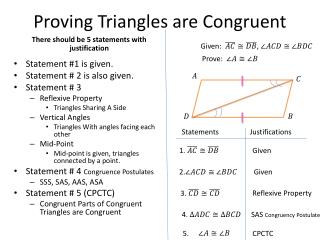
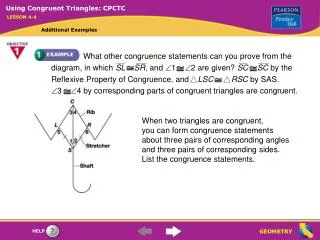
Using Congruent Triangles: CPCTC LESSON 4-4 Additional Examples What other congruence statements can you prove from the diagram, in which SL SR, and 1 2 are given? SCSC by the Reflexive Property of Congruence, and LSCRSC by SAS. 3 4 by corresponding parts of congruent triangles are congruent. When two triangles are congruent, you can form congruence statements about three pairs of corresponding angles and three pairs of corresponding sides. List the congruence statements.
Sides: SLSR Given SCSC Reflexive Property of Congruence CLCR Other congruence statement Angles: 1 2 Given 3 4 Corresponding Parts of Congruent Triangles CLS CRS Other congruence statement In the proof, three congruence statements are used, and one congruence statement is proven. That leaves two congruence statements remaining that also can be proved: CLSCRS CLCR Using Congruent Triangles: CPCTC LESSON 4-4 Additional Examples (continued) Quick Check
Using Congruent Triangles: CPCTC LESSON 4-4 Additional Examples The Given states that DEG and DEF are right angles. What conditions must hold for that to be true? DEG and DEF are the angles the officer makes with the ground. So the officer must stand perpendicular to the ground, and the ground must be level. Quick Check