
Innovative Compression/Release Stabilization for Transfemoral Prostheses Enhances Mobility
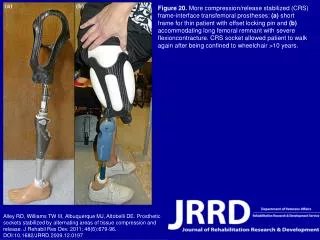
The study presents advancements in transfemoral prostheses utilizing compression/release stabilization (CRS) to improve user mobility. Two designs are highlighted: (a) a short frame for thin patients featuring an offset locking pin, and (b) a design accommodating long femoral remnants with severe flexion contracture. The CRS socket technology enabled a patient, who had been wheelchair-bound for over a decade, to walk again, showcasing its transformative impact. This research could redefine rehabilitation strategies for individuals with similar conditions.

Innovative Compression/Release Stabilization for Transfemoral Prostheses Enhances Mobility
E N D
Presentation Transcript
Figure 20. More compression/release stabilized (CRS) frame-interface transfemoral prostheses: (a) short frame for thin patient with offset locking pin and (b) accommodating long femoral remnant with severe flexioncontracture. CRS socket allowed patient to walk again after being confined to wheelchair >10 years. Alley RD, Williams TW III, Albuquerque MJ, Altobelli DE. Prosthetic sockets stabilized by alternating areas of tissue compression and release. J Rehabil Res Dev. 2011; 48(6):679-96.DOI:10.1682/JRRD.2009.12.0197