Download
1 / 8
80 likes | 192 Vues
Explore the history of medicine through the ages, from Hippocrates and Aristotle to the advancements of the Renaissance and modern science. Discover how early physicians identified natural causes of disease through the concept of the four humors and the relationship between anatomy and physiology. Delve into the significant contributions made during the Islamic Golden Age and the breakthroughs of the 18th to 20th centuries, including the development of cell theory and the perfection of microscopes. This narrative captures the essence of medical terminology, anatomy, and the quest for understanding human health.

E N D
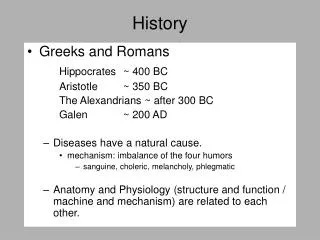
History • Greeks and Romans Hippocrates ~ 400 BC Aristotle ~ 350 BC The Alexandrians ~ after 300 BC Galen ~ 200 AD • Diseases have a natural cause. • mechanism: imbalance of the four humors • sanguine, choleric, melancholy, phlegmatic • Anatomy and Physiology (structure and function / machine and mechanism) are related to each other.
History • Fall of the Western Roman Empire Dark Ages in Europe • Islamic Contributions • Preserved and improved on Greek and Roman science • Arabic numerals • Arabic words • Al-gebra • Al-cohol • Cotton • Al-godon
http://www.callisto.si.usherb.ca/~croisade/IMAGES/Hagia_sophia.jpghttp://www.callisto.si.usherb.ca/~croisade/IMAGES/Hagia_sophia.jpg Byzantine Greek St. Sophia – 6th Century A.D. Istanbul (formerly Constantinople) Taj Mahal - India St. Basil - Moscow http://designbuild.construction.com/MasterBuilders/0600MB.asp http://members.aol.com/_ht_a/TWalls1068/page4/Basil.JPG
History • Renaissance • Translation of Greek classics into Latin • Human Dissection • Vesalius – physician / anatomist - 1543
History • 18th, 19th and 20th Centuries • Chemistry • 1828 – Wöhler synthesizes urea • Today – Genetic Engineering, Cloning
Cell Theory • Late 17th C. – Robert Hooke and Antony Van Leeuwenhoek • Cells seen in microscopes. • 1830’s – Schleiden and Schwann • The cell is the basic unit of life for all plants and animals. • 1850’s Virchow [plus Pasteur] • All cells come from other cells. • Late 1800’s – light microscope perfected (1000 x magnification) • 1950’s – electron microscope perfected ( >100,000 x magnification)
Medical Terminology • Anatomy = study of structure (the machine) ana = “up”; tomy = to cut anatomy = to cut up, to dissect [Greek based] [Latin based] • Physiology = study of function (the mechanism) physio = nature; logy = study of [same root as physics] Normal function requires energy. The First and Second Laws of Thermodynamics apply.
Medical Terminology • Homeostasis = normal operating condition steady state (dynamic) • homeo: similar to • cf. homo: same as [Nicene Creed ~ 400 A.D.] • stasis: standing / condition • “The various physiologic arrangements which serve to restore the normal state once it has been disturbed.” – W.B. Cannon