Exploring Transcendentalism: A Guide to Spirituality, Society, and Self-Realization
This guide examines key statements reflecting on transcendentalist beliefs, inviting personal reflection on spirituality, individuality, and societal norms. It poses various questions regarding the importance of spirituality versus worldly experiences, life concerns, and rational versus intuitive thinking. Additionally, the text delves into the moral foundations of American transcendentalism, exploring how its principles have shaped significant social movements while highlighting influential thinkers like Emerson and Thoreau. Engage with each statement to either agree or disagree, articulating your reasoning for deeper insight.

Exploring Transcendentalism: A Guide to Spirituality, Society, and Self-Realization
E N D
Presentation Transcript
Anticipation Guide For each statement, indicate whether you agree or disagree and explain your reasons. 1. Spirituality is more important to me than worldly experience. 2. I am more concerned with this life than the next. 3. I see God in all things. • I believe rational thinking (thinking based on science and logic) is more reliable than intuitive thinking (thinking based on emotion and perception). 5. I think society is usually wrong about most things. 6. I don’t think it is right to break any law – even an unjust law.
Vocabulary (in binder) • Philosophy (n)- Love and search of wisdom • Rational (v)- having reason or understanding • Intuition (n) – feeling or “gut” instinct • Civil Disobedience- non violent refusal to obey authority
Transcendentalism • Transcendentalism is – • a major American literary movement • a philosophy- love and search for wisdom • a state of mind • a form of spirituality • It is NOT a religion; it can be applied to different faiths • Basic assumption: Intuition, rather than rationality, is the means for understanding the connection between yourself, the world, and God.
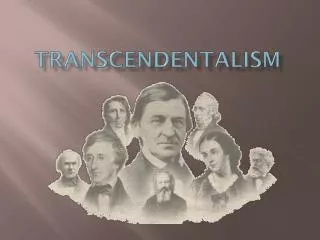
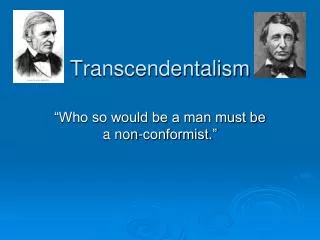
History • Transcendentalism is deeply rooted in American history: • inspired by the deep morality of the Puritans and Quakers • associated with Romanticism – an artistic movement that valued individuality, emotion, and nature over reason and society. • Most well-know transcendentalist writers: • Ralph Waldo Emerson • Henry David Thoreau • Margret Fuller
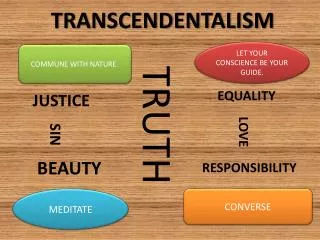
Basic Transcendentalist Ideas • The individual is the center of the universe • Individual happiness depends on self-realization • Every individual should be respected • God is within all of us • God is found in nature and human nature • There is a relationship between all things • Nature is symbolic - a living mystery full of signs • Miracles are all around us • People should be more concerned with this life than the next • Death should not be feared • People should not be afraid to change their minds • People must be self-reliant and independent • The logic of society is often wrong
Legacy of Transcendentalism • Influenced American writers: • Edgar Allan Poe • Nathaniel Hawthorne • Herman Melville • Walt Whitman • Emily Dickinson • Henry David Thoreau • Ralph Waldo Emerson • Influenced the idea of civil disobedience • Gandhi • MLK • Influenced 1960’s movements • Hippies • Anti-war movement • Black Power movement • Feminism