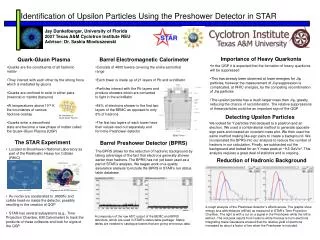
Investigating Quarkonia Melting in QCD Plasma at STAR Facility
140 likes | 246 Vues
Explore the melting of heavy quarkonia states in QCD plasma by studying color screening in static potential, using lattice QCD to evaluate spectral functions leading to sequential state disappearance revealing deconfinement. Key authors Satz and Matsui proposed J/ψ suppression as thermometer. Understand the melting temperatures for different states like J/ψ, Υ', cc, Υ states, and evaluate their roles as detectors in STAR facility. Analysis involves techniques like EMC detectors, electron identification, and mass resolution. Preliminary results show consistency with pQCD and world data, presenting a pathway for future research at STAR facility.


Investigating Quarkonia Melting in QCD Plasma at STAR Facility
E N D
Presentation Transcript
Upsilon production in STAR Pibero Djawotho Indiana University Cyclotron Facility October 12, 2007 DNP 2007
Why Quarkonia? Charmonia: J/y, Y’, ccBottomonia: (1S), (2S), (3S) Key Idea: Melting in the plasma • Color screening of static potential between heavy quarks: • J/ysuppression: Matsui and Satz, Phys. Lett. B 178 (1986) 416 • Suppression of states is determined by TC and their binding energy • Lattice QCD: Evaluation of spectral functions Tmelting • Sequential disappearance of states: Color screening Deconfinement QCD thermometer Properties of QGP When do states really melt? Tdiss(y’) Tdiss(cc)< Tdiss((3S)) < Tdiss(J/y) Tdiss((2S)) < Tdiss((1S)) H. Satz, HP2006
J/y, y’ J/y likely to melt at RHIC y’ melts at RHIC Pros moderate rate J/y and y’ can be separated Cons co-mover absorption affects yield recombination affects yield trigger only in pp (still low eff.) moderate electron PID in J/y momentum range , ’, ’’ (1S) no melting at RHIC standard candle (reference) (2S) likely to melt at RHIC (analog J/y) (3S) melts at RHIC (analog y’) Pros co-mover absorption negligible recombination negligible at RHIC STAR efficient trigger and large acceptance Cons extremely low rate need good resolution to separate 3 S states and J/y States in STAR STAR’s strength are the states
STAR Detectors Used for Quarkonia • EMC • Acceptance: || < 1 , 0 < < 2 • PID with EMC detectors • Tower (energy) p/E • High-energy tower trigger enhance high-pT sample • Essential for quarkonia triggers • Luminosity limited for
STAR Trigger • Sample -triggered Event • e+e- • mee = 9.5 GeV/c2 • cosθ = -0.67 • E1 = 5.6 GeV • E2 = 3.4 GeV charged tracks • Similar L0+L2 triggers • Higher mass state higher energy threshold • Pros: Easier and cleaner to trigger • Cons: Small yield; need large luminosity and acceptance • Full EMC acceptance |η|<1 in Run 6 • Integrated luminosity ≈ 9 pb-1 in Run 6
STAR Mass Resolution • STAR detector is able to resolve individual states of the albeit: • Finite p resolution • e-bremsstrahlung • Yield is extracted from combined ++ states • FWHM ≈ 1 GeV/c2 W.-M. Yao et al. (PDG), J. Phys. G 33, 1 (2006); R. Vogt et al., RHIC-II Heavy Flavor White Paper
d K p p electrons preliminary preliminary Analysis: Electron ID with TPC and EMC e π preliminary • trigger enhances electrons • Use TPC for charged tracks selection • Use EMC for hadron rejection • Electrons identified by dE/dx ionization energy loss in TPC • Select tracks with TPC, match to EMC towers above 3 GeV
preliminary preliminary in Run 6 p+p at √s=200 GeV:Invariant Mass • Signal + Background unlike-sign electron pairs • Background like-sign electron pairs • (1S+2S+3S) total yield: integrated from 7 to 11 GeV from background-subtracted mee distribution • Peak width consistent with expected mass resolution • Significance of signal is 3σ
preliminary in Run 6 p+p at √s=200 GeV:Cross Section =geo×L0×L2×2(e)×mass • geo is geometrical acceptance • L0 is efficiency of L0 trigger • L2 is efficiency of L2 trigger • (e) is efficiency of e reco • mass is efficiency of mass cut
preliminary STAR Run 6 Cross Section in p+p at Midrapidity at √s=200 GeV
preliminary STAR vs. Theory and World Data STAR 2006 √s=200 GeV p+p ++→e+e- cross section consistent with pQCD and world data
trigger threshold No N+++N-- subtracted Scaling from Au+Au to elementary: a=1 Past: in Run 4 Au+Au at √sNN=200 GeV • Cannot resolve different S states (1S+2S+3S) e+e- • STAR • Large acceptance (|h| < 1, full EMC) • PID for electrons (EMC, TPC) • Trigger • Very efficient > 80% • Luminosity limited STAR Preliminary • First look in 2004: ½ EMC, little statistics • 90% C.L.: signal < 4.91 • B·ds/dy C.L. < 7.6 mb
preliminary Future:Run 7 Au+Au at √sNN=200 GeV Trigger • 605.69 μb-1 integrated luminosity for L2-upsilon during Run 7 • ~37 expected at y=0 for |y|<0.5 or ~70 for |y|<1. Assume: • S/B=48/83 significance 3.3σ from 2006 p+p at √s=200 GeV • Binary scaling and nuclear effects σAB=σpp(AB)α
Summary and Outlook • Full EMC + trigger quarkonium program in STAR • Run 6: first midrapidity measurement of ++→e+e- cross section at RHIC in p+p collisions at √s=200 GeV • Bee×(dσ/dy)y=0=91±28(stat.)±22(syst.) pb • STAR in p+p measurement is consistent with pQCD and world data • Run 7: expect cross section at midrapidity in Au+Au collisions at √s=200 GeV (37-70 raw yield) and nuclear modification factorRAA