Crafting Effective Problem Statements for Senior Design Projects
Understanding how to clearly define a problem is crucial in any design project. Inspired by Einstein's quote, it's essential to invest time in defining your project's challenge before jumping to solutions. A well-structured problem statement provides clarity and focus, guiding your efforts toward effective solutions. This guide outlines the steps to create a solid problem statement, emphasizing clear, concise language and relevant data. By engaging in team discussions and utilizing structured approaches, you can articulate the challenges your project aims to address.

Crafting Effective Problem Statements for Senior Design Projects
E N D
Presentation Transcript
Problem Statements Senior Design Project Proposal
Define the problem! • Einstein is quoted as having said that if he had one hour to save the world he would spend fifty-five minutes defining the problem and only five minutes finding the solution. • This quote does illustrate an important point: before jumping right into solving a problem, we should step back and invest time and effort to improve our understanding of it.
What is a problem statement? • Writing a problem statement can be a problem if you don’t know what one is. • Knowing how to write one involves knowing what it is not: • not a vague proposition (“I want to build a robot”) • not an explanation of how to do something (“Ya see when I was at summer camp, I got to wire lights together to make this cool thing”)
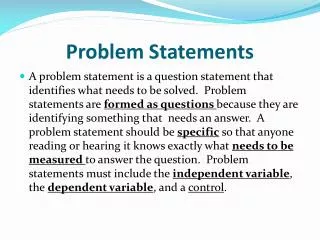
What is a problem statement? • The problemstatement (or needs assessment) is the key element of a proposal. • It should be a clear, concise, well-supported statement of the problemto be overcome. • The information provided should be both factual and directly related to the problem that will be addressed by the proposal. • You cannot have a solution without identifying the problem it will solve.
What is a problem statement? • The first step is to write down what you think your identified problem is, • Don’t worry too much about quality at this point – simply making a start is significant. • Next, expand on your problem by asking the following questions: • who does it affect / who does it not affect. • what does it effect / what does it not affect. • how does it effect / how does it not affect. • when is it a problem / when is it not a problem. • where is it a problem / where is it not a problem.
Hmmmm, Problems? • Suggestions: • No public access to bathroom facilities, • Wheelchair stowage on aircraft, • No power during inclement weather, • Alternative energy transportation for urban areas, • Visitors in large buildings get lost, • Lack of funding for an organization, • Cell phones dropping calls, • Not being able to use USB’s on school owned computers,
How to write the problem statement. • Begin the statement with: • The problem identified is……. • During the course of this project a solution will be developed for the following identified problem…… • While many problems were identified our team chose to focus on the ……..as our main focus. • Use correct grammar, and punctuation.
What is your problem? • Get together in teams of three and discuss the various ideas you have for your Senior Design project, • Draft a problem statement for each of your ideas that identifies the problem that you are identifying.
Bibliography • http://thinkinghow.com/writing-a-problem-statement/ • http://webcache.googleusercontent.com/search?q=cache:X63zTxVbft8J:www.oaklandcc.edu/hlenglish/lin%2520armitage/Lin825/Eng1350ProblemStatementWorksheetF05.doc+how+to+write+a+problem+statement&cd=5&hl=en&ct=clnk&gl=us