Understanding the Biased Sample Fallacy in Statistics
The Biased Sample Fallacy occurs when conclusions about a population are drawn from a sample that is unrepresentative in some way. This fallacy can lead to inaccurate generalizations and misguided decisions. For instance, if surveys indicate that 55% of those polled in certain states spend considerable time near the ocean, it would be erroneous to conclude that 55% of all Americans do the same, especially if the sample isn't representative of the broader population. Recognizing this fallacy is crucial for proper statistical analysis.

Understanding the Biased Sample Fallacy in Statistics
E N D
Presentation Transcript
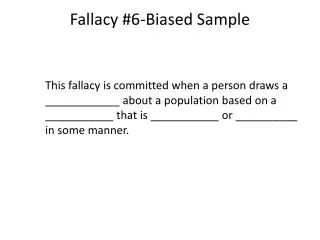
Fallacy #6-Biased Sample This fallacy is committed when a person draws a ____________ about a population based on a ___________ that is ___________ or __________ in some manner.
Example • Large scale polls were taken in Florida, California, and Maine and it was found that an average of 55% of those polled spent at least fourteen days a year near the ocean. So, it can be safely concluded that 55% of all Americans spend at least fourteen days near the ocean each year.