Investigating Engine-Driven Supernovae Associations with Gamma-Ray Bursts
This presentation by Alicia M. Soderberg at the Caltech Astronomy Department Zwicky Supernova Workshop aims to explore the relationship between Type Ib/c supernovae and gamma-ray bursts (GRBs). Covering the significance of radio observations and their role in probing the fastest ejecta of supernovae, it examines the properties of specific cases like SN 1998bw and SN 2003L, emphasizing their lightcurves and energetic output. The ongoing Caltech/NRAO survey continues to shed light on the diversity of these cosmic events and their central engines.

Investigating Engine-Driven Supernovae Associations with Gamma-Ray Bursts
E N D
Presentation Transcript
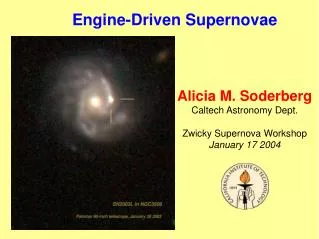
Engine-Driven Supernovae Alicia M. Soderberg Caltech Astronomy Dept. Zwicky Supernova Workshop January 17 2004
Engines in GRBs Continuous energy input from an accrection disk (many times the dynamical timescale) produces a multi-peak lightcurve.
SN 1998bw is discovered within the error box of GRB 980425. SN is highly energetic GRB is sub-energetic Radio emission requires relativistic ejecta and variable energy input. SN1998bw and GRB980425April 25.91 1998 (Kulkarni et al. 1998; Li & Chevalier 1999)
observer SN1998bw – an engine-driven SN Case2 : quasi-spherical relativistic ejecta (unknown %) Case 1: off-axis (0.5 %) observer observer
Purpose:to determine the association between type Ib/c supernovae and GRBs through evidence for relativistic ejecta as a proxy for a central engine. Also: to study the diversity of energetics of type Ib/c SNe. Why Radio Observations? i. Radio probes the fastest ejecta within the SN. ii. Radio is less sensitive to geometrical effects. 1999-2002: “piggyback” project with GRBs. Sep 2002-present: First systematic survey: we observe every type Ib/c within 100 Mpc accessible with the VLA. The Caltech/NRAO Radio Supernova Survey
Type Ibc Radio Lightcurves (Kulkarni et al., 1998; Weiler et al. 1998)
Type Ibc Radio Lightcurves 1999-2002: 28 limits & SN2002ap (Berger et al. 2002)
Type Ibc Radio Lightcurves 1999-2002: 28 limits & SN2002ap 2003-present: 23 limits & SN2003L SN/GRB < 2% (Soderberg et al. in prep.)
Type Ic SN 2003L in NGC 3506 Optical Discovery: Jan 12 2003 (Boles, IAUC 8048) MV = -18.8 (before maximum) d = 92 Mpc Spectroscopic ID: Jan 25, 2003 (Valenti et al. IAUC 8057; Matheson et al. GCN 1846) normal Ic; v~5900 - 12,000 km/s cf: SN1998bw: v~15,000 - 30,000 km/s cf: SN2003dh: v~20,000 - 40,000 km/s
Preliminary Constraints on the Expansion Velocity 1.) VLBA observations: 2003 March 7.30 UT (t = 65 days) r < 1018 cm (0.12 mas), Г < 2-3 c.f.: SN1998bw: t~30 days r~1017 cm (0.2 mas), v~c 2.) Minimum Energy: We can determine the size of the source assuming equipartition between particles and magnetic field. t~85 days, 2.8 mJy, 8.5 GHz r = 2.7 x 1016 cm <v> = 0.13 c
Equipartition Results: SN2003L ejecta is BRIGHT but not unusually fast
Radio Supernova Modelling Emission: Synchrotron Radiation from particles swept up by the ejecta (FS). Electrons are accelerated to a power-law distribution described by: N(E) ~ E-p Absorption: 1.) Synchrotron Self-Absorption (SSA) at low frequencies produces a turn-over in the spectrum. => source size/velocity 2.) Free-Free Absorption (FFA) in the CSM may produce additional absorption. => environment/density
SN2003L Modeling Results (Soderberg et al. in prep.)
Implications: Energy Radius Mass Loss Density
Compare to SN 1998bw:(Li & Chevalier 1999) Energy Radius Mass Loss Density
SN2003L and Other Cosmic Explosions: SN 2003L
SN2003bg – another energetic SN 2003L & 2003bg
Type Ibc Radio Lightcurves 1999-2002: 28 limits & SN2002ap 2003-present: 23 limits & SN2003L &SN2003bg (Kulkarni et al., 1998; Weiler et al. 1998; Berger et al. 2002)
SN2003bg – Multiple Episodes of Energy Input ? SN2003bg: Energy~3 SN1998bw: Energy=2.6 (Soderberg et al., 2004)
Conclusions • We are continuing our radio survey to assess the fraction of type Ib/c supernovae powered by an engine (stay tuned). • We detected strong radio emission from SN2003L & SN2003bg with peak luminosity ~30% that of SN1998bw. • Analysis of the SN 2003L radio emission indicates v~0.1cand E~3x1048 erg(cf. SN1998bw: ~2 and E~1050 erg), as well asn ~ r -2 and (dM/dt) ~2 x 10⁻⁷ Mo/yr(cf. SN1998bw: 3 x 10⁻⁷ Mo/yr). • With the exception of SN1998bw, SN2003L is the most energetic radio supernova detected to date, but there is no clear evidence for a central engine. • Analysis of the multi-frequency observations (X-ray, optical) will help us to better constrain the total energetics, etc.