Download
1 / 53
540 likes | 670 Vues
This study investigates the retention of deuterium in tungsten exposed to carbon-seeded deuterium plasma. It explores the effects of substrate temperature and carbon deposition on deuterium retention. Results indicate that carbon contamination significantly increases deuterium retention in tungsten, primarily residing in carbon films formed during the deposition process. Additionally, the characteristics of the tungsten surface, such as the formation of blisters and pits, are influenced by temperature variations. These findings have implications for material migration and erosion in nuclear fusion environments.

E N D
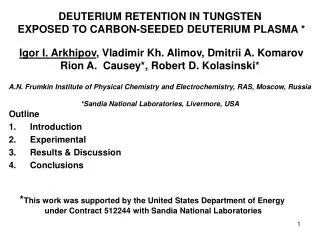
DEUTERIUM RETENTION IN TUNGSTENEXPOSED TO CARBON-SEEDED DEUTERIUM PLASMA *Igor I. Arkhipov, Vladimir Kh. Alimov, Dmitrii A. KomarovRion A. Causey*, Robert D. Kolasinski*A.N. Frumkin Institute of Physical Chemistry and Electrochemistry, RAS, Moscow, Russia*Sandia National Laboratories, Livermore, USA Outline • Introduction • Experimental • Results & Discussion • Conclusions *This work was supported by the United States Department of Energy under Contract 512244 with Sandia National Laboratories
Introduction Irradiation conditions [1] G.Federici et al., J. Nucl. Mater. 313-316 (2003) 11-22 [2] J.P. Coad, et.al., J. Nucl. Mater. 313-316 (2003) 419-423 [3] F.C. Sze et.al., J. Nucl. Mater. 266-269 (1999) 1212-1218 [4] M.Poon, et al., J. Nucl. Mater. 337-339 (2005) 629-633 [5] This work
Introduction Irradiation conditions [1] G.Federici et al., J. Nucl. Mater. 313-316 (2003) 11-22 [2] J.P. Coad, et.al., J. Nucl. Mater. 313-316 (2003) 419-423 [3] F.C. Sze et.al., J. Nucl. Mater. 266-269 (1999) 1212-1218 [4] M. Poon, et al., J. Nucl. Mater. 337-339 (2005) 629-633 [5] This work
Introduction Material migration in divertor tokamaks Distribution of erosion/deposition areas in the JET divertor (1999-2001)* *P.Coad, et al., J. Nucl. Mater. 313-316 (2003) 419
Sputtering yields curves for fusion relevant materials for irradiation by deuterium*(Physical sputtering yields for some ion mass are plotted in the case of W) Introduction Erosion of carbon by deuterium 100 *G.F. Matthews, J. Nucl. Mater. 337-339 (2005) 1-9
Introduction Material migration in divertor tokamaks Scheme of erosion/re-deposition processes within the divertor* *G.F. Matthews, J. Nucl. Mater. 337-339 (2005) 1-9
Ion impact energy at the outer divertor target for a completely detached N2 seeded shorts in JET. The effect of ELMs of different sizes is shown* Introduction Erosion of tungsten by tritium *G.F. Matthews, J. Nucl. Mater. 337-339 (2005) 1-9
Introduction D retention in C seeded D-plasma exposed W Experimental results • Dominant factors: 1. substrate temperature 2. whether carbon is deposited on the W surface • There is a carbon-impurity concentration of beginning of C-deposition: • 0.75% at 850 K • 1% at 750 K • Uncontaminated surface: 1. Blisters, bubbles and/or pits are formed 2. D retention decreases with temperature increase • C-contaminated surface: 1. a-C:D film or/and W2C layer are formed 2. D retention in C-contaminated W larger than in uncontaminated one • The most of deuterium are residing in the carbon films • Thin a-C:D film or W2C layer can significantly decrease D-retention in W
Introduction D retention in C seeded D-plasma exposed W Experimental results • Dominant factors: 1. substrate temperature 2. whether carbon is deposited on the W surface • There is a carbon-impurity concentration of beginning of C-deposition: • 0.75% at 850 K • 1% at 750 K • Uncontaminated surface: 1. Blisters, bubbles and/or pits are formed 2. D retention decreases with temperature increase • C-contaminated surface: 1. a-C:D film or/and W2C layer are formed 2. D retention in C-contaminated W larger than in uncontaminated one • The most of deuterium are residing in the carbon films • Thin a-C:D film or W2C layer can significantly decrease D-retention in W
Introduction D retention in C seeded D-plasma exposed W Experimental results • Dominant factors: 1. substrate temperature 2. whether carbon is deposited on the W surface • There is a carbon-impurity concentration of beginning of C-deposition: • 0.75% at 850 K • 1% at 750 K • Uncontaminated surface: 1. Blisters, bubbles and/or pits are formed 2. D retention decreases with temperature increase • C-contaminated surface: 1. a-C:D film or/and W2C layer are formed 2. D retention in C-contaminated W larger than in uncontaminated one • The most of deuterium are residing in the carbon films • Thin a-C:D film or W2C layer can significantly decrease D-retention in W
Introduction D retention in C seeded D-plasma exposed W Experimental results • Dominant factors: 1. substrate temperature 2. whether carbon is deposited on the W surface • There is a carbon-impurity concentration of beginning of C-deposition: • 0.75% at 850 K • 1% at 750 K • Uncontaminated surface: 1. Blisters, bubbles and/or pits are formed 2. D retention decreases with temperature increase • C-contaminated surface: 1. a-C:D film or/and W2C layer are formed 2. D retention in C-contaminated W larger than in uncontaminated one • The most of deuterium are residing in the carbon films • Thin a-C:D film or W2C layer can significantly decrease D-retention in W
Sputtering yields curves for fusion relevant materials for irradiation by deuterium*(Physical sputtering yields for some ion mass are plotted in the case of W) Introduction Erosion of tungsten by carbon 100 *G.F. Matthews, J. Nucl. Mater. 337-339 (2005) 1-9
W erosion as function of Te and C impurity concentration* Introduction Erosion of tungsten by carbon *K. Schmid, J. Roth, J. Nucl. Mater. 313-316 (2003) 302-310
Introduction In this work: Partially contaminated surface in C-seeded D-plasma
Experimental Top view of magnetron cathode surface (6×8×0.5 mm3) Ta mask
Experimental Irradiation conditions [1] G.Federici et al., J. Nucl. Mater. 313-316 (2003) 11-22 [2] J.P. Coad, et.al., J. Nucl. Mater. 313-316 (2003) 419-423 [3] F.C. Sze et.al., J. Nucl. Mater. 266-269 (1999) 1212-1218 [4] M.Poon, et al., J. Nucl. Mater. 337-339 (2005) 629-633 [5] This work
Experimental Irradiation conditions *Ei≈ZUsheath + 2Ti ≈ Te(3Z+1), Usheath≈3Te/e0 Ti≈Te/2 Ei- ion impact energy Z- charge state of the impacting ion Usheath- sheath potential Te& Ti – temperatures of electrons and ions [1] G.Federici et al., J. Nucl. Mater. 313-316 (2003) 11-22 [2] J.P. Coad, et.al., J. Nucl. Mater. 313-316 (2003) 419-423 [3] F.C. Sze et.al., J. Nucl. Mater. 266-269 (1999) 1212-1218 [4] M.Poon, et al., J. Nucl. Mater. 337-339 (2005) 629-633 [5] This work
Experimental Irradiation conditions [1] G.Federici et al., J. Nucl. Mater. 313-316 (2003) 11-22 [2] J.P. Coad, et.al., J. Nucl. Mater. 313-316 (2003) 419-423 [3] F.C. Sze et.al., J. Nucl. Mater. 266-269 (1999) 1212-1218 [4] M.Poon, et al., J. Nucl. Mater. 337-339 (2005) 629-633 [5] This work
W erosion as function of Te and C impurity concentration* Introduction Erosion of tungsten by carbon *K. Schmid, J. Roth, J. Nucl. Mater. 313-316 (2003) 302-310
Experimental Experimental conditions * T=770 K **T=1030 K [1] R. Fraunfelder, J. Vac. Sci.Technol. 6 (1969) 388 [2] K. Schmid, J. Roth, J. Nucl. Mater. 313-316 (2003) 302-310
Experimental Erosion of tungsten Estimation: V erosion=1.5-2 μm/30 min ~1 nm/s ~6×10¹⁹ at.W/m2s Initial surface Closed area Eroded surface Plasma-impact area Interference fringes (Linnik micro-interferometer)
Sputtering yields curves for fusion relevant materials for irradiation by deuterium*(Physical sputtering yields for some ion mass are plotted in the case of W) Experimental Erosion of tungsten by carbon *G.F. Matthews, J. Nucl. Mater. 337-339 (2005) 1-9
Experimental Experimental conditions * T=770 K **T=1030 K 1%C in plasma: 1018 C/m2s→1017 W/m2s [1] R. Fraunfelder, J. Vac. Sci.Technol. 6 (1969) 388 [2] K. Schmid, J. Roth, J. Nucl. Mater. 313-316 (2003) 302-310
Experimental The threshold energies of sputtering
Experimental DEUTERIUM RETENTION IN TUNGSTENAT HIGH LEVEL OF SURFACE EROSION
Experimental Experimental conditions * T= 773 K **T=1030 K [1] R. Fraunfelder, J. Vac. Sci.Technol. 6 (1969) 388 [2] K. Schmid, J. Roth, J. Nucl. Mater. 313-316 (2003) 302-310
Diffusion coefficient for C in a wide concentration range for C in W* Introduction *K. Schmid, J. Roth, J. Nucl. Mater. 313-316 (2003) 302-310
Experimental Experimental conditions * T= 773 K **T=1030 K [1] R. Fraunfelder, J. Vac. Sci.Technol. 6 (1969) 388 [2] K. Schmid, J. Roth, J. Nucl. Mater. 313-316 (2003) 302-310
Experimental Experimental conditions * T= 773 K **T=1030 K [1] R. Fraunfelder, J. Vac. Sci.Technol. 6 (1969) 388 [2] K. Schmid, J. Roth, J. Nucl. Mater. 313-316 (2003) 302-310
Experimental H diffusivity vs temperature for W 773 K E. Serra, G. Benamati, O.V. Ogorodnikova, J. Nucl. Mater. 255 (1998) 105-115
Experimental H diffusivity vs temperature for W 773 K R. Fraunfelder, J. Vac. Sci.Technol. 6 (1969) 388
Experimental H diffusivity vs temperature for W 773 K A.P. Zakharov, V.M. Sharapov, E.I. Evko, Soviet Mater. Sci. 9 (1973) 149
Experimental Experimental conditions * T= 773 K **T=1030 K Kdiffusion ~ 1× 10⁻⁹ m2s-1→h=(Dt)1/2~ 1mm [1] R. Fraunfelder, J. Vac. Sci.Technol. 6 (1969) 388 [2] K. Schmid, J. Roth, J. Nucl. Mater. 313-316 (2003) 302-310
Experimental Methods of the analysis C/D-plasma irradiation: planar DC magnetron Eions (D2+; C+; N+, O+, Ta+)= 400 eV Flux=1×10¹⁹ D/m2s, 30 min Mechanically & electrochemically polished Hot-rolled tungsten foil (99.0 at.%) Size = 6×8×0.5 mm3 • Profiles & chemical state of impurities: • X-ray Photoelectron Spectroscopy (XPS) • Depth profiles of C, O, W • 3 kev Ar+, 2×2 mm2, 0.4 μm • Deuterium profiles: • Nuclear Reaction Analysis (NRA): • 0 - 0.5 μm: D(3He,α)H reaction • 0.5 - 7 μm: D(3He,p)4He reaction • Deuterium retention: • Thermal Desorption Spectroscopy (TDS) • D2 & HD molecules were detected by QMS • Temperature range: 300-1100 K • Heating rate = 3.2 K/s
Results & Discussion NRA & TDS data m 6
Results & Discussion NRA data 3
Results & Discussion XPS data (3 keV Ar at fluence=1×10¹⁹ Ar/m2 )
Results & Discussion NRA data 3
Results & Discussion Blistering in the temperature range 363-653 K Pre-TDS; T=563 K at fluence=2× 1024 D/m2
Results & Discussion TDS data
Results & Discussion TDS data T1=650-710 K T2=900-1000 K
Results & Discussion TDS modeling:contributions from 1.4 eV traps and blisters (TMAP7)at 563 K
Three types of traps can explain our TDS data • Near-surface layer (≤ 0.5 m): 1.4 eV traps= one D in vacancy 2. Sub-surface layer (≤ 7 m): 1.8-2.1 eV= D chemisorption on blister/bubble wall + D2 molecules inside 3. Bulk (up to 1 mm): 1.8-2.1 eV traps= D chemisorption on inner walls of small cavity and voids
Results & Discussion NRA & TDS data m Bulk trapping !
Results & Discussion General experimental results • Strong W sputtering • Blistering • Enhanced D retention • NRA ≈ TDS from 363 to 563 K • NRA<<TDS from 563 to 773 K
Conclusions General conclusions • Blistering & enhanced D retention even at strong W surface sputtering are revealed • Irradiation temperature of 550-600 K corresponds to transition from a near/sub-surface to a bulk D trapping in polycrystalline W foils • Carbon influence: enhanced W erosion; W2C barrier layer formation & increased D retention
Conclusions General conclusions • Blistering & enhanced D retention even at strong W surface sputtering are revealed • Irradiation temperature of 550-600 K corresponds to transition from a near-surface to a bulk D trapping in polycrystalline W • Carbon influence: enhanced W erosion; W2C barrier layer formation & enhanced D retention
Conclusions General conclusions • Blistering & enhanced D retention even at strong W surface sputtering are revealed • Irradiation temperature of 550-600 K corresponds to transition from a near-surface to a bulk D trapping in polycrystalline W • Carbon influence: enhanced W erosion; W2C barrier layer formation & enhanced bulk D retention
Scheme of plasma-surface interaction No erosion D-C plasma D stop diffusion & retention 4 nm W a-C:H film Carbon-modified layer (W2C, WC)