Electromagnetic Probes at RHIC
440 likes | 549 Vues
This presentation by Stefan Bathe analyzes the role of electromagnetic radiation as a probe of the quark-gluon plasma (QGP) in heavy-ion collisions at the Relativistic Heavy Ion Collider (RHIC). It discusses the unique properties of electromagnetic radiation, including its minimal interaction with the medium and its ability to carry information about the early stages of collisions. The presentation highlights key phenomena such as thermal radiation, medium modifications, and quarkonia studies. It also touches on dileptons and direct photons, providing insights into temperature measurements and dynamics of the QGP.


Electromagnetic Probes at RHIC
E N D
Presentation Transcript
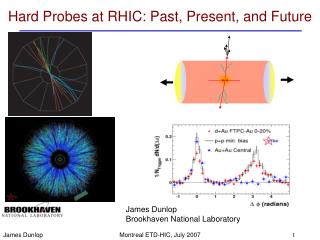
Electromagnetic Probes at RHIC Stefan BatheUC Riverside ETD-HIC07, Montreal, July 19, 2007
Em radiation: a probe of the qgp Electromagnetic Radiation: A Probe of the QGP • EM radiation not strongly interacting • Once produced, leaves collision region unscathed • Carries information about early times • Serves as baseline for other probes Stefan Bathe
g p0 e+ g* e- Mass Landscape of EMRad Mass landscape of EMR • p0 and h Dalitz decay • thermal radiation from real and virtual photons • light vector mesons and low-mass continuum • mass shifts, broadening, excess yield? • open heavy flavor • thermal radiation • medium modification • quarkonia • medium modification Quarkonia: topic of its own schematic dilepton mass distribution Di-leptons via charged particle tracking & PID Stefan Bathe
pT landscape of EMR pT Landscape of EMRad Dileptons and direct photons: • two topics • linked at low mass • physics (thermal radiation) • measurement (via dileptons) • Thermal radiation from the medium • Temperature of QGP • Medium response to jets • Jet photons, induced bremsstrahlung • Prompt photons • Baseline for medium modification of jets Ch. Gale, QM05 Direct photons with EMCal Thermal photons also by internal/external conversion! Stefan Bathe
1. Dileptons Stefan Bathe
Chiral Symmetry Restoration Chiral symmetry restoration • One of two fundamental properties of QGP (besides deconfinement) • Low-mass dileptons most sensitive probe • Primarily through r meson decays • t=1.3 fm/c (fireball 10 fm/c) • Most decays in medium Low-mass excess at SPS: observed by CERES (Pb+Au) confirmed by NA60 in (In+In) NA60 Nucl. Phys. A774, 43 (2006) Phys. Rev. Lett. 96, 162302 (2006) Stefan Bathe
R. Shahoyan, QM06 NA60, In+In centralcollisions R. Shahoyan, QM06 M (GeV/c2) Thermal radiation Thermal Radiation • Promise: initial temperature of QGP Intermediate-mass excess at SPS: observed by NA50 (Pb+Pb) Shown to be prompt by NA60 (In+In) Stefan Bathe
Raw Mass Distribution submitted to Phys. Rev. Lett arXiv:0706.3034 Raw mass distribution Converter run • bg 2.5x larger • spectra consistent Systematic error 0.25% B/S (bg substraction) 9% S (cross pair subtraction, below 600 MeV/c2) Continuum, w, f, J/y visible Au+Au 200 GeV Small S/B w f J/y Run-4 (improved analysis compared to previous preliminary result) Stefan Bathe
submitted to Phys. Rev. Lett arXiv:0706.3034 Invariant mass distribution Invariant Mass Distribution • Low-Mass Continuum • enhancement in 150 <mee<750 MeV • Intermediate-Mass • Data consistent with Pythia • PYTHIA single e- softer for p+p, but coincide for Au+Au • Angular correlations expected to weaken in Au+Au • Room for thermal contribution Stefan Bathe
submitted to Phys. Rev. Lett arXiv:0706.3034 Low-mass: Comparison with theory Low mass: comparison with theory Broad-range enhancement:150 < mee < 750 MeV3.4±0.2(stat.) ±1.3(syst.)±0.7(model) Include chiral symmetry restoration and thermal radiation R.Rapp, Phys.Lett. B 473 (2000) R.Rapp, Phys.Rev.C 63 (2001) R.Rapp, nucl-th/0204003 Stefan Bathe
submitted to Phys. Rev. Lett arXiv:0706.3034 Centrality Dependence Centrality dependence • p0 production ~ Npart • If in-medium enhancement from pp or qq annihilation yield should increase > ~ Npart Low mass charm follows binary scaling yield should increase ~ Ncoll Intermediate mass peripheral central Stefan Bathe
Invariant mass distribution in p+p Invariant Mass Distribution in p+p Good agreement with hadronic cocktail except for intermediate-mass region N.B.: PYTHIA known to be softer than p+p datafrom single e- analysis Stefan Bathe
p+p – Au+Au comparison First evidence for radiation from early stage of collision! (measured p+p reference) p+p normalized to mee<100 MeV/c2 p+p and Au+Au normalized to p0 region Agreement at resonances (w, f) Au+Au enhancement for 0.2 < mee < 0.8 GeV Agreement in intermediate mass and J/ just for ‘coincidence’(J/ happens to scale as p0 due to scaling with Ncoll + suppression) arXiv:0706.3034) Stefan Bathe
signal electron Cherenkov blobs e- partner positron needed for rejection e+ qpair opening angle ~ 1 m The future: HBD The Future: Hadron Blind Detector • Dalitz & Conversion rejection via opening angle • Identify electrons in field free region • Veto signal electrons with partner projection, 10 B evtents PHENIX from Run-7 on Stefan Bathe
2. Direct Photons Stefan Bathe
The promise and the peril The promise and the peril Promises (two of them) • Initial temperature, transition temperature via thermal photons • Jet energy scale, precise energy loss via g-jet correlations Peril • Richer probe than originally thought (medium-induced photons) • Old idea of unfolding photon sources (starting from the clearly- understood high-pT spectra and moving down in pT) seriously challenged Stefan Bathe
pQCD or prompt photons (as N+N, but modified) Non-thermal thermal Hard+thermal Pre-equili-brium photons QGP Hadron gas Initial hardscattering from medium Interaction of hardparton with QGP 1) and 2) Medium induced photon bremsstrahlung Photon sources in A+A Photon Sources in A+A Photons in A+A Direct Photons Decay Photons Stefan Bathe
Disentangling Sources Disentangling sources <pT> vs. creation time in principle: working one’s way down from the highest pT (and excluding hadron decays) one might be able to disentangle different sources hard scatt. pT (GeV) jet brems. jet-thermal sQGP hadron decays hadron gas log t 1 10 107 (fm/c) Stefan Bathe
Actual calculation Actual calculations C. Gale, NPA 785, 93c (2007) Very difficult to disentangle sources Stefan Bathe
Direct photon elliptic flow Direct Photon Elliptic Flow • Jet-photons and induced photon bremsstrahlung: out-of-plane, negative v2 • Jet-quenching less fragmentation photons: in-plane, positive v2 Elliptic flow helps to disentangle various contributions Stefan Bathe
3 1 2 4 Disentangling++ Disentangling the contributions contribution softer v2 isol. 1 compton, annihi. =0 yes 2 jet-thermal <0 yes 3 fragmentation >0 no 4 induced. brems. <0 no v2 and isolation help to disentangle contributions Gale, NPA 785, 93c (2007) Stefan Bathe
While data and pQCD calculation consistent, data tend to be higher than pQCD by at least 20%, increasing to low and high pT Data Fit P+p from Run-5 p+p from Run-5 Stefan Bathe
Direct Photon RAA Direct photon RAA RAA with pQCD reference RAA with data reference RAA with p+p data First direct photon RAA using p+p data as reference Stefan Bathe
Comparison to p0 Comparison to pi0 Direct photons and p0 touch at highest pT Direct g RAA with measured p+p reference data g hp0 • Still consistent with • final state effect for p0 and initial state effect for direct photons • Modification of structure function? • different for p0 and direct photons Stefan Bathe
Theory comparison I, II Theory comparison I, II • Turbide et al. • Jet photons + pQCD + thermal • AMY formalism for jet-quenching of fragmentation photons • Data systematically below theory • Phys. Rev. C72 (2005) 014906 + private communication • F. Arleo • pQCD photons only • High-pT suppression due to isospin effect, shadowing, and energy loss • BDMPS for jet-quenching • JHEP 0609 (2006) 015 Stefan Bathe
Theory comparison III Theory comparison III • B.G. Zakharov, • Bremsstrahlung photons through bulk matter • JETP Lett. 80 (2004) 1 Stefan Bathe
Is the suppression real? Can suppression be confirmed? • By going to smaller collision energy (200 GeV->62 GeV), modification of structure function can be tested at smaller pT (24 GeV->~7.5 GeV) • Advantage: independent detector systematics (no cluster merging) • Caveat: other direct photons sources may come into play (Run5) p+p data” to NLO pQCD Au+Au, 62.4 GeV minimum bias • Result still suffers from large uncertainties • Needs higher-statistics run and p+p measurement at same energy • Ideally structure function measurement in p+A • Other tests • PbGl (PbGl better spatial resolution than PbSc) • RxNP (shadowing should be RxNP independent) Stefan Bathe
Towards thermal photons: conversion measurements Towards thermal photons: conversion measurements Confirmation from external conversion Internal conversion in Au+Au Needs p+p reference measurement Almost there (see dilepton result) Internal conversion in d+Au Still too large uncertainties to draw a conclusion Stefan Bathe
Photon-tagged jets Photon-tagged Jets Trigger particle Because of energy loss, di-jet measurement suffers from surface bias No trigger surface bias for direct photon tagged jets Direct photon is measure of jet energy di-jet Hadrons Associated particle g g-jet More on this in Saskia’s talk Hadrons Stefan Bathe
Summary and Outlook • Electromagnetic radiation in HI collisions comprises two subfields • Dileptons • Direct photons • Coupled at low mass by physics and measurement techniques • PHENIX dielectron measurement in Au+Au (combined w/ baseline p+p) provides first evidence for early-time radiation at RHIC • Interpretation of direct photon measurements challanged by previously non-thought-of sources (medium modifications) • New measurements (conversion, v2, isolation) combined with future high-luminosity runs and detector upgrades will help to solve the puzzle • STAR has entered the game, healthy competition for PHENIX Stefan Bathe
Extra Slides Stefan Bathe
gg HBT D1 h/R Dp 2 d R 1 D2 L Dp The Hanbury-Brown-Twiss method of photon interferometry works from stars to nuclei! 3/2 1+f 2/2 f 1 Stefan Bathe Dp
Two-photon correlations e+ g2 g2rec g1 g1 e- External conversion: • No cluster interference • No hadron contamination C2 calculated from EMCal only and conversion+EMCal agree => detector effects under control Stefan Bathe
Inclusive g-h Decay g-h contribution (via p0-hadron) Direct g-h ! g-Jet Correlations p+p collisions at 200 GeV Stefan Bathe
Comparison to Pythia Stefan Bathe
g-Jet Correlations in AuAu Stefan Bathe
PHENIX Cu+Cu – jet E-scale systematic from Rg systematic from subtraction method Stefan Bathe
The Spectrum Compare to NLO pQCD • L.E.Gordon and W. Vogelsang • Phys. Rev. D48, 3136 (1993) • above (questionable) pQCD Compare to thermal model • D. d’Enterria, D. Perresounko • nucl-th/0503054 2+1 hydro T0ave=360 MeV(T0max=570 MeV) t0=0.15 fm/c • data above thermal at high pT Compare to thermal + pQCD • data consistent with thermal + pQCD • Needs confirmation from p+p measurement Stefan Bathe
Internal conversion: d+Au Fit measured mass spectrum with function: a - absolute normalization b – fraction of direct photons: Stefan Bathe
p+p–Au+Au comparison both normalized to mee<100 MeV/c2 p+p multiplied by Npart/2 p+p multiplied by Ncoll p+p and Au+Au normalized to p0 region Agreement at resonances (w, f) Au+Au enhancement for 0.2- mee < 0.8 GeV Agreement in intermediate mass and J/ just for ‘coincidence’(J/ happens to scale as p0 due to scaling with Ncoll + suppression) arXiv:0706.3034) Stefan Bathe
RAA with pQCD reference RAA with p+p data Direct Photon RAA First direct photon RAA using p+p data as reference Stefan Bathe
First g-jet results Ettrigger from 8.5GeV/c to 10.5 GeV • Both STAR and PHENIX have first g-jet results • So far more proof-of-principle than precise measurements • Need higher-statistics run Stefan Bathe
Measurement measurement g • 3: Isolation • Can be applied in p+p and very-high-pT Au+Au • Large background from decay photons • Three methods • 1: Statistical • Measure inclusive photons • Measure main sources of decay photons (p0, h) • Calculate spectrum of decay photons from measurement • Subtract decay photons from inclusive photons • applied at all pT • 2: Conversion • similar to dilepton measurement • Low pT only p0 g Leading Particle Hadrons frag. g q Direct g Stefan Bathe
Current v2 results Future improvements: more statistics, RxNP detector, internal conversion Stefan Bathe