Download
1 / 23
230 likes | 348 Vues
This document presents a comprehensive overview of Hidden Markov Processes (HMP) focusing on entropy computation through a statistical mechanics lens. It begins with an introduction to HMP, defines the related problem, and utilizes upper bounds from Cover & Thomas to analyze entropy behaviors across different regimes. Additionally, the paper discusses the Markovian property, the Ising model, and conjectures on entropy rates, along with future directions for research. The aim is to shed light on the complexities of entropy in HMP and outline potential avenues for further exploration.

E N D
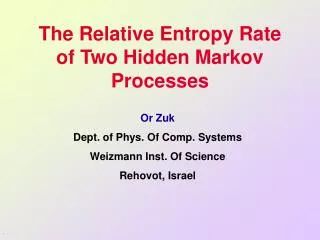
Entropy of Hidden Markov Processes Or Zuk1 Ido Kanter2 Eytan Domany1 Weizmann Inst.1 Bar-Ilan Univ.2 .
Overview • Introduction • Problem Definition • Statistical Mechanics approach • Cover&Thomas Upper-Bounds • Radius of Convergence • Related subjects • Future Directions
Markov Process: X – Markov Process M – Transition Matrix Mij = Pr(Xn+1 = j| Xn = i) M Xn Xn+1 N N Yn Yn+1 HMP - Definitions • Hidden Markov Process : • Y – Noisy Observation of X • N – Noise/Emission Matrix • Nij = Pr(Yn = j| Xn = i)
p(1|0) p(0|0) 0 p(1|1) 1 p(0|1) q(0|0) q(1|1) q(1|0) q(0|1) 1 0 Example: Binary HMP Transition Emission
Example: Binary HMP (Cont.) • For simplicity, we will concentrate on Symmetric Binary HMP : • M = N = • So all properties of the process depend on two parameters, p and . Assume (w.l.o.g.) p, < ½
HMP Entropy Rate • Definition : H is difficult to compute, given as a Lyaponov Exponent (which is hard to compute generally.) [Jacquet et al 04] • What to do ? Calculate H in different Regimes.
Different Regimes p -> 0 , p -> ½ ( fixed) -> 0 , -> ½ (p fixed) [Ordentlich&Weissman 04] study several regimes. We concentrate on the ‘small noise regime’ -> 0. Solution can be given as a power-series in :
Statistical Mechanics First, observe the Markovian Property : Perform Change of Variables :
- + + + - + + - - - - + + + + - Statistical Mechanics (cont.) Ising Model : , {-1,1} Spin Glasses 2 1 n J J K K n 2 1
Statistical Mechanics (cont.) Summing, we get :
Statistical Mechanics (cont.) Computing the Entropy (low-temperature/high-field expansion) :
Cover&Thomas Bounds It is known (Cover & Thomas 1991) : • We will use the upper-bounds C(n), and derive their orders : • Qu : Do the orders ‘saturate’ ?
Cover&Thomas Bounds (cont.) • Ans : Yes. In fact they ‘saturate’ sooner than would have been expected ! For n (K+3)/2 they become constant. We therefore have : • Conjecture 1 : (proven for k=1) • How do the orders look ? Their expression is simpler when expressed using = 1-2p, which is the 2nd eigenvalue of P. • Conjecture 2 :
First Few Orders : • Note : H0-H2 proven. The rest are conjectures from the upper-bounds.
Radius of Convergence : When is our approximation good ? Instructive : Compare to the I.I.D. model For HMP, the limit is unknown. We used the fit :
Relative Entropy Rate • Relative entropy rate : • We get :
Index of Coincidence • Take two realizations Y,Y’ (of length n) of the same HMP. What is the probability that they are equal ? Exponentially decaying with n. • We get : • Similarly, we can solve for three and four (but not five) realizations. Can give bounds on the entropy rate.
Future Directions • Proving conjectures • Generalizations (e.g. any alphabets, continuous case) • Other regimes • Relative Entropy of two HMPs Thank You