Understanding Cavity Wall Rain Screen Effect and Components in Masonry Construction
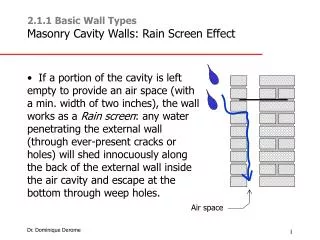
Cavity walls can effectively manage water penetration through a rain screen effect, provided there is an air space of at least two inches within the cavity. This air space allows water that enters the external wall—via cracks or holes—to flow down the back of the wall and escape through weep holes at the bottom. Essential components in this system include brick veneer, flashing, insulation, sheathing with an air barrier, and the structural support of steel studs, which are secured to the concrete slab for stability.

Understanding Cavity Wall Rain Screen Effect and Components in Masonry Construction
E N D
Presentation Transcript
2.1.1 Basic Wall TypesMasonry Cavity Walls: Rain Screen Effect • If a portion of the cavity is left empty to provide an air space (with a min. width of two inches), the wall works as a Rain screen: any water penetrating the external wall (through ever-present cracks or holes) will shed innocuously along the back of the external wall inside the air cavity and escape at the bottom through weep holes. Air space
Brick Veneer, Steel Stud BackupDesignation of theComponents (Contd.) • Brick Veneer • Flashing • Insulation • Sheathing + Air Barrier • Structure of the Building • Steel Studs • ...
Brick Veneer, Steel Stud BackupComponents Description: Steel Studs The steel tracks are themselves attached to the top and bottom surfaces of the concrete slab using expansion bolts(1) driven in the concrete. Note that on the bottom side of the slab, a double telescoping track(2) is specified (see next slide). (1) (2)