Understanding the Purpose and Guidelines of a Child’s Portfolio
A portfolio is an ongoing collection that showcases a child's work and learning journey. It includes various materials such as artwork, writings, photographs, and teacher notes, capturing significant experiences and demonstrating growth. Portfolios serve multiple purposes: they reflect individual learning, enhance communication, and promote self-awareness. By featuring proud achievements and showcasing unique learning processes, portfolios assist in assessing children's development. This guide outlines what to include, how to organize the portfolio, and questions to consider during preparation.

Understanding the Purpose and Guidelines of a Child’s Portfolio
E N D
Presentation Transcript
What is a portfolio? • An ongoing collection of a child’s work and documentation of learning • Includes a wide range of materials. • Portfolio pieces may include drawings and artwork, writing samples, photographs, notes from teachers and friends, assessments. • Includes classroom and studio work
What is the portfolio’s purpose? • Demonstrating learning • Communicating experiences and learning • Capturing the learning process • Demonstrating thinking and problem solving • Assessment: paper/pencil and authentic • Evidence of experiences of the child • Expression • Developing self awareness and self esteem • Offering children, teachers, parents opportunity to wonder • Reflecting • Demonstrating quality
Portfolio Guidelines What goes into the portfolio? • Work the child is proud of and wants to include • Work that shows uniqueness • Demonstration of learning: success or a failure • Could be an end product or process • Always has intention, a reason for going in portfolio • Include core curriculum areas • Include real life experiences • Include awards and performances • Work showing a pattern of growth and improvement • Benchmarks or milestones
How are portfolios organized? • Organized to exemplify who a child is and how a child learns • Two descriptions to choose from when filling out the “section” portfolio label. • Who I am • How I learn
Who I Am Evidence of a child’s… • Relating and connecting to the world • Growing and changing (Physically, emotionally, mentally) • Building relationships and making friends • Communicating and expressing • Habits and traits • Values • Hopes and dreams • A philosophy of life (how does a child approach life, learning, relating to others)
How I Learn Evidence of a child’s … • Wondering • Exploring • Discovering • Achieving (not standard grades, but how a child succeeds) • Mastering a concept • Theories • Learning style • Problem solving • Facing challenges • Using Languages (visual arts, speaking and writing) • Metacognition (one’s perception of their own learning)
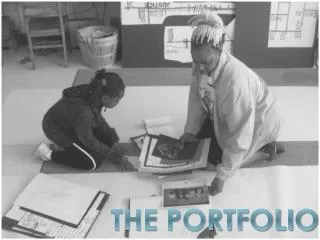
Teachers prepare environment with long white paper and 4 portfolios for review
Children and parents sort the portfolio work
Suggested Session Format • 5 Minutes – Meet and share agenda • 20 Minutes – Lay out or sort work from portfolio onto white paper • 20 Minutes – Walk around and reflect on the learning of others; leave notes • 15 Minutes – Children put away work while parents write messages; snacks are served in the dining room for those who are interested.
Teachers set up a space for parents to write letters to their children.
Questions to Help Prepare Portfolios • Older children often have too much work to sort through. Should work ever be removed? • What guidelines can we create for removing work?
Our Thoughts on 3.31.11 • Focus on the current year to keep fresh? • K-1 has pressure to create body of work • Children in older grades have too much work to look through in the given time • Plan to have children pick work ahead of time; helps facilitate digging through too much work; • Uphold criteria; have benchmark work • Writing, self portrait, who I am, how I learn • What else? • Talk about sorting out work at plus/delta