GFP: Can we do better?
GFP has been widely used in molecular biology for over two decades, yet various challenges persist. Many GFP variants have a slow folding rate, limiting fluorescence activation to over an hour after synthesis. New potential tags such as hAGT-O6-benzylguanine offer exciting opportunities for protein labeling by utilizing the methyl-transferase properties of the hAGT protein. Additionally, alternatives like Oligo-His-Ni2+-NTA and FlAsH tagging show promise but come with their own limitations and require specific conditions for optimal performance.

GFP: Can we do better?
E N D
Presentation Transcript
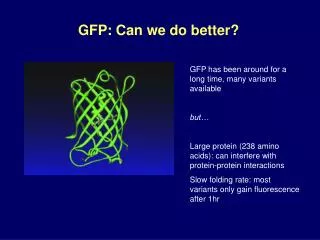
GFP: Can we do better? GFP has been around for a long time, many variants available but… Large protein (238 amino acids): can interfere with protein-protein interactions Slow folding rate: most variants only gain fluorescence after 1hr
Possible future tags? hAGT-O6-benzylguanine-fluorophore (hAGT) 207 amino acid tag Uses methyl-transferase property of hAGT, a DNA repair protein hAGT labelling of proteins Oligo-His-Ni2+-nitrilotriacetate (NTA) 10 amino acid tag NTA binds Ni2+ complexed to protein the NTA fluorophore
FlAsH Tagging FlAsH tagging Requires 6 amino acid tag (Cys-Cys-X-X-Cys-Cys ) Reagent and tag are non-fluorescent until they bind together Membrane permeable Limited background from endogenous Cys-containing proteins. FlAsH EDT