Download
1 / 3
30 likes | 133 Vues
Delve into the properties of solids, liquids, and gases, understanding their structures and behaviors. Discover the unique characteristics of each state of matter and the fascinating science behind phase transitions and conservation of energy. Join our exploration today!

E N D
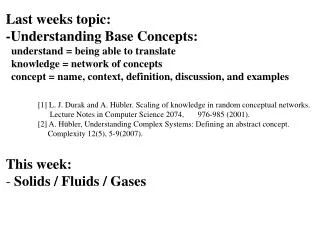
Last weeks topic: • -Understanding Base Concepts: • understand = being able to translate • knowledge = network of concepts • concept = name, context, definition, discussion, and examples • [1] L. J. Durak and A. Hübler. Scaling of knowledge in random conceptual networks. • Lecture Notes in Computer Science 2074, 976-985 (2001). • [2] A. Hübler, Understanding Complex Systems: Defining an abstract concept. • Complexity 12(5), 5-9(2007). • This week: • Solids / Fluids / Gases
Solids, Fluids, and Gases • Solid: • rock, wood, water ice, dry ice (ball) • atoms are close, most rigidly packed and do not change • position => definite volume • elastic = returns to original shape after being squeezed or • stretched => definite shape • Liquids: • water, oil, clay, liquid nitrogen (vases) • atoms are close, densely packed, and change position => definite volume • viscous = does not return to original shape after being squeezed or stretched • => nodefinite shape • Gas: • vapor, air, oxygen gas, nitrogen gas • atoms are far apart and change position => no definite volume (N2 cannon) • viscous = does not return to original shape after being squeezed or stretched • => nodefinite shape • Simulation => phase transitions are sharp & energy is conserved
Last weeks topic: • -Understanding Base Concepts • [1] L. J. Durak and A. Hübler. Scaling of knowledge in random conceptual networks. Lecture Notes in Computer Science 2074, 976-985 (2001). • [2] A. Hübler, Understanding Complex Systems: Defining an abstract concept. Complexity 12(5), 5-9(2007). • This week: • Solids / Fluids / Gases • I have research opportunities in my lab.