
Mock-Up Human Arm Model for Torque and Inertia Experiments in Rehabilitation
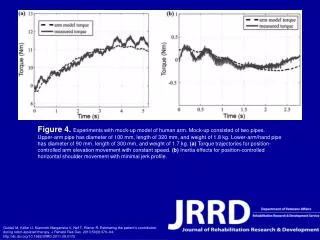
This study explores a mock-up model of a human arm designed to simulate upper and lower arm movements. The upper arm pipe measures 100 mm in diameter, 320 mm in length, and weighs 1.8 kg. The lower arm/hand pipe has a diameter of 90 mm, a length of 300 mm, and weighs 1.7 kg. Experimental findings include torque trajectories for position-controlled arm elevation movement at constant speed, as well as the effects of inertia for position-controlled horizontal shoulder movements utilizing a minimal jerk profile.

Mock-Up Human Arm Model for Torque and Inertia Experiments in Rehabilitation
E N D
Presentation Transcript
Figure 4. Experiments with mock-up model of human arm. Mock-up consisted of two pipes. Upper-arm pipe has diameter of 100 mm, length of 320 mm, and weight of 1.8 kg. Lower-arm/hand pipe has diameter of 90 mm, length of 300 mm, and weight of 1.7 kg. (a) Torque trajectories for position-controlled arm elevation movement with constant speed. (b) Inertia effects for position-controlled horizontal shoulder movement with minimal jerk profile. Guidali M, Keller U, Klamroth-Marganska V, Nef T, Riener R. Estimating the patient’s contribution during robot-assisted therapy. J Rehabil Res Dev. 2013;50(3):379–94.http://dx.doi.org/10.1682/JRRD.2011.09.0172