
Comprehensive Guide to Evaluating Savings Plans: Strategies for Optimal Returns
This guide explores key aspects of evaluating savings plans, focusing on understanding rates of return, the impact of compounding interest, and calculating the Effective Annual Rate (EAR). It discusses the influence of inflation on savings returns and the importance of tax considerations that can affect overall earnings. Additionally, it addresses liquidity, highlighting how easily funds can be accessed, and safety measures such as the Canadian Deposit Insurance Corporation (CDIC) protection. Lastly, it covers potential fees and restrictions that could impact account performance.

Comprehensive Guide to Evaluating Savings Plans: Strategies for Optimal Returns
E N D
Presentation Transcript
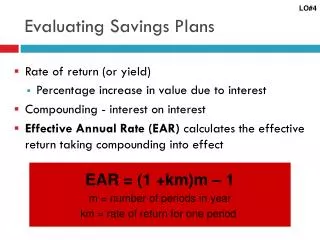
LO#4 Evaluating Savings Plans • Rate of return (or yield) • Percentage increase in value due to interest • Compounding - interest on interest • Effective Annual Rate (EAR) calculates the effective return taking compounding into effect EAR = (1 +km)m – 1 m = number of periods in year km = rate of return for one period
LO#4 Evaluating Savings Plans • Inflation • Compare return with inflation rate • Tax considerations • Taxes reduce interest earned • Liquidity • Ease with which you can convert to cash with a minimal loss of principal
LO#4 Evaluating Savings Plans • Safety • Canadian Deposit Insurance Corporation (CDIC) insures up to a maximum $100,000 per person per financial institution • Restrictions and Fees • Delay between when interest earned and added to your account • Transaction fees for each deposit or withdrawal • Interest paid only with minimum balance