Understanding the Concept of "Tame" and Its Religious Implications in Scripture
50 likes | 199 Vues
The term "טמא" (tame) in Hebrew, pronounced "taw-may," translates to "defiled" or "polluted." It signifies a state of being unclean, often linked to idolatrous practices and various abominations outlined in religious texts. Notable references include serving other gods, practicing sorcery, cross-dressing, engaging in sodomy, and offering defective sacrifices. These actions are deemed abominable and cause moral and spiritual impurity. The discussion explores how these practices are perceived in religious law and ethics, highlighting their impact on community and divine favor.


Understanding the Concept of "Tame" and Its Religious Implications in Scripture
E N D
Presentation Transcript
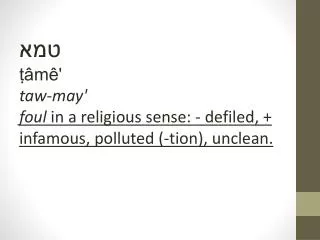
טמא ṭâmê' taw-may' foulin a religious sense: - defiled, + infamous, polluted (-tion), unclean.
שׁקץ sheqets sheh'-kets filth, that is, (figuratively and specifically) an idolatrous object: - abominable (-tion).
שׁקץ • Serving other gods Deu_13:14 & Deu_17:4 • Sorcery Deu_18:12 • Cross-Dressing Deu_22:5 • Sodomy Lev_18:22 Lev_20:13 • Sacrifice a defective animal Deu_17:1 • False scales Pro_11:1 • A crooked-hearted Pro_11:20 • Lying lips Pro_12:22 • An unjust person Pro_29:27