
80 likes | 222 Vues
This summary discusses the key scientific drivers for experiments enabled by NSLS-II, focusing on areas like catalysis, materials science, and phase transformations. It outlines the necessary technical capabilities, including multiple beamlines with specific requirements for detectors, software, and computing infrastructure. The need for advanced robotic integration, real-time data analysis, and efficient position-sensitive detectors is emphasized. Additionally, it reviews community size estimates and outreach needs, highlighting the importance of collaboration and support for these initiatives.
E N D
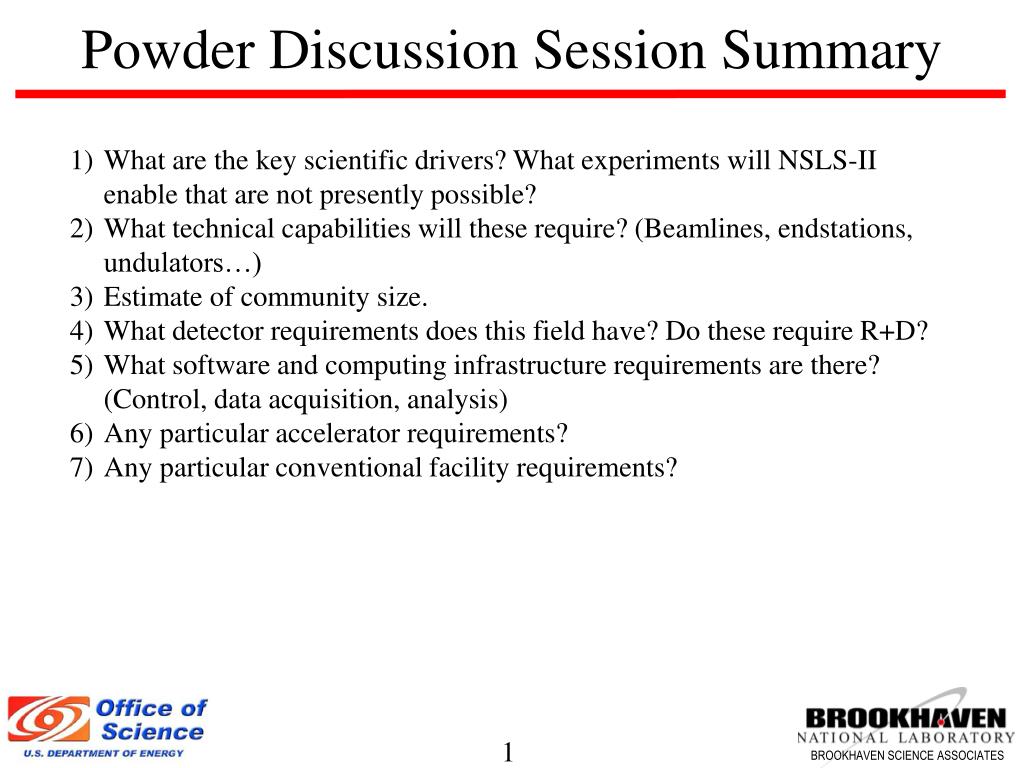
Powder Discussion Session Summary What are the key scientific drivers? What experiments will NSLS-II enable that are not presently possible? What technical capabilities will these require? (Beamlines, endstations, undulators…) Estimate of community size. What detector requirements does this field have? Do these require R+D? What software and computing infrastructure requirements are there? (Control, data acquisition, analysis) Any particular accelerator requirements? Any particular conventional facility requirements?
Possible layout • Two wiggler beamlines (programs? Instruments?) • DAC? Multi-xtal? Strip-detector? • Fixed-setup / multi-purpose? • 3-pole wiggler / NSLS mover ?
What are the key scientific drivers? What experiments will NSLS-II enable that are not presently possible? • Can provide key insights in the micron – nanometer scale • Combinatorial chemistry and industrial processes • Catalytic chemistry • Materials defects • Nucleation, growth / phase transformation / chemical kinetics • Extreme conditions • Faster, smaller • higher throughput
What technical capabilities will these require? (Beamlines, endstations, undulators…) • Several beamlines • Should be geographically close • SCW would be preferable for some experiments • Both focused and unfocused beamlines are needed • Environmental chambers • Sample changers • Detectors and software • Sample characterisation / preparation in labs • High throughput • Tricky environment
Estimate of community size • Wide range of communities with some commonalities • Need to develop mailing list / do outreach
What detector requirements does this field have? Do these require R+D? • Efficient position-sensitive detectors at higher energies • Large solid-angle • Graded solid angle for good high-q statistics • Wide dynamic range (10^6)
What software and computing infrastructure requirements are there? (Control, data acquisition, analysis) • robotic integration • Analysis software • Visualization and analysis in real time: this is real bottleneck • Needs dedicated professional software effort to accomplish this • Interactive detector setup software
Any particular accelerator requirements?Any particular conventional facility requirements? • Superconducting wiggler • Laser-heating • Cryogenics • Adequate power