Download
1 / 35
350 likes | 482 Vues
This chapter explores the complexities of life's transitions, focusing on aging, coping mechanisms, and the experience of grief and loss. It outlines various definitions of age that influence societal factors like voting rights, the psychological stages of coping with impending death, and how bereavement manifests following the loss of a loved one. Additionally, it discusses common mental health challenges in older adults, including dementia, and provides insights into the adaptive capacities that shape how individuals navigate their later years.

E N D
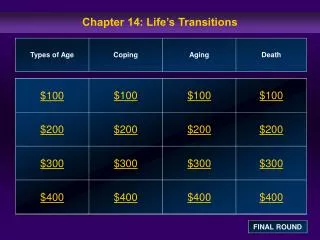
Chapter 14: Life’s Transitions Types of Age Coping Aging Death $100 $100 $100 $100 $200 $200 $200 $200 $300 $300 $300 $300 $400 $400 $400 $400 FINAL ROUND
Types of Age:$100 Question • What definition of age is used as a factor in determining voting rights? • a. Social • b. Legal • c. Biological • d. Functional ANSWER BACK TO GAME
Types of Age:$100 Answer • What definition of age is used as a factor in determining voting rights? • a. Social • b. Legal • c. Biological • d. Functional BACK TO GAME
Types of Age:$200 Question • A person’s adaptive capacities, such as coping abilities and intelligence, define • a. functional age. • b. psychological age. • c. legal age. • d. social age. ANSWER BACK TO GAME
Types of Age:$200 Answer • A person’s adaptive capacities, such as coping abilities and intelligence, define • a. functional age. • b. psychological age. • c. legal age. • d. social age. BACK TO GAME
Types of Age:$300 Question • The “young-old” are people who are • a. 45-54 years of age. • b. 55-64 years of age. • c. 65-74 years of age. • d. 75-84 years of age. ANSWER BACK TO GAME
Types of Age:$300 Answer • The “young-old” are people who are • a. 45-54 years of age. • b. 55-64 years of age. • c. 65-74 years of age. • d. 75-84 years of age. BACK TO GAME
Types of Age:$400 Question • Functional age can be described as • a. maintaining independence by living alone. • b. being able to read and understand the newspaper. • c. being interested in the activities offered at the senior center. • d. ways one compares to others of a similar age. ANSWER BACK TO GAME
Types of Age:$400 Answer • Functional age can be described as • a. maintaining independence by living alone. • b. being able to read and understand the newspaper. • c. being interested in the activities offered at the senior center. • d. ways one compares to others of a similar age. BACK TO GAME
Coping:$100 Question • The loss or deprivation that a survivor experiences when a loved one dies defines • a. mourning. • b. bereavement. • c. grief. • d. disenfranchised grief. ANSWER BACK TO GAME
Coping:$100 Answer • The loss or deprivation that a survivor experiences when a loved one dies defines • a. mourning. • b. bereavement. • c. grief. • d. disenfranchised grief. BACK TO GAME
Coping:$200 Question • In this psychological stage of coping with death a person may say, “It’s really going to happen to me, and I can’t do anything about it.” • a. Anger • b. Depression • c. Bargaining • d. Acceptance ANSWER BACK TO GAME
Coping:$200 Answer • In this psychological stage of coping with death a person may say, “It’s really going to happen to me, and I can’t do anything about it.” • a. Anger • b. Depression • c. Bargaining • d. Acceptance BACK TO GAME
Coping:$300 Question • Which dimension of coping with loss involves identifying what matters in life and reaffirming meaningful experiences? • a. Social • b. Psychological • c. Spiritual • d. Physical ANSWER BACK TO GAME
Coping:$300 Answer • Which dimension of coping with loss involves identifying what matters in life and reaffirming meaningful experiences? • a. Social • b. Psychological • c. Spiritual • d. Physical BACK TO GAME
Coping:$400 Question • Common symptoms of grief may include all of the following except: • a. Increased appetite • b. Excessive speech • c. Insomnia • d. Difficulty concentrating ANSWER BACK TO GAME
Coping:$400 Answer • Common symptoms of grief may include all of the following except: • a. Increased appetite • b. Excessive speech • c. Insomnia • d. Difficulty concentrating BACK TO GAME
Aging:$100 Question • According to the autoimmune theory, aging is caused by • a. an increased number of cells exhibiting unusual or different characteristics with increased age. • b. the body’s cells having reached the end of their reproductive life. • c. the decline of the body’s immunological system. • d. the human body wearing out. ANSWER BACK TO GAME
Aging:$100 Answer • According to the autoimmune theory, aging is caused by • a. an increased number of cells exhibiting unusual or different characteristics with increased age. • b. the body’s cells having reached the end of their reproductive life. • c. the decline of the body’s immunological system. • d. the human body wearing out. BACK TO GAME
Aging:$200 Question • What is the most common form of dementia in older adults? • a. Alzheimer’s disease • b. Parkinson’s disease • c. Depression • d. Psychosis ANSWER BACK TO GAME
Aging:$200 Answer • What is the most common form of dementia in older adults? • a. Alzheimer’s disease • b. Parkinson’s disease • c. Depression • d. Psychosis BACK TO GAME
Aging:$300 Question • Which eye condition often associated with aging is the breakdown of the light-sensitive part of the retina responsible for sharp, direct vision needed to read? • a. Cataracts • b. Macular degeneration • c. Glaucoma • d. Nearsightedness ANSWER BACK TO GAME
Aging:$300 Answer • Which eye condition often associated with aging is the breakdown of the light-sensitive part of the retina responsible for sharp, direct vision needed to read? • a. Cataracts • b. Macular degeneration • c. Glaucoma • d. Nearsightedness BACK TO GAME
Aging:$400 Question • Which disease is characterized by low bone density and structural deterioration leading to porous, fragile bones? • a. Osteoarthritis • b. Osteopenia • c. Osteoporosis • d. Osteomalacia ANSWER BACK TO GAME
Aging:$400 Answer • Which disease is characterized by low bone density and structural deterioration leading to porous, fragile bones? • a. Osteoarthritis • b. Osteopenia • c. Osteoporosis • d. Osteomalacia BACK TO GAME
Death:$100 Question • This is the study of death and dying. • a. Thanatology • b. Gerontology • c. Ageism • d. Senescence ANSWER BACK TO GAME
Death:$100 Answer • This is the study of death and dying. • a. Thanatology • b. Gerontology • c. Ageism • d. Senescence BACK TO GAME
Death:$200 Question • The form of “mercy killing” that refers to ending the life of a person who is suffering greatly and has no chance of survival is called • a. rational suicide. • b. passive euthanasia. • c. suicide. • d. active euthanasia. ANSWER BACK TO GAME
Death:$200 Answer • The form of “mercy killing” that refers to ending the life of a person who is suffering greatly and has no chance of survival is called • a. rational suicide. • b. passive euthanasia. • c. suicide. • d. active euthanasia. BACK TO GAME
Death:$300 Question • Hospice programs include all of the following characteristics except: • a. Emphasis on pain alleviation • b. Patients accepted based on ability to pay • c. Care of family extends through bereavement • d. Coverage is 24 hours a day ANSWER BACK TO GAME
Death:$300 Answer • Hospice programs include all of the following characteristics except: • a. Emphasis on pain alleviation • b. Patients accepted based on ability to pay • c. Care of family extends through bereavement • d. Coverage is 24 hours a day BACK TO GAME
Death:$400 Question • _________ is the term for dying without a will. • a. Intestate • b. Holographic will • c. Testator • d. Next of kin ANSWER BACK TO GAME
Death:$400 Answer • _________ is the term for dying without a will. • a. Intestate • b. Holographic will • c. Testator • d. Next of kin BACK TO GAME
FINAL ROUND Question • Which statement is not true concerning changes in the body as a result of the aging process? • a. Skin becomes thinner • b. Ability to withstand extreme temperatures decreases • c. Brain shrinks in size • d. Need to urinate decreases ANSWER BACK TO GAME
FINAL ROUND Answer • Which statement is not true concerning changes in the body as a result of the aging process? • a. Skin becomes thinner • b. Ability to withstand extreme temperatures decreases • c. Brain shrinks in size • d. Need to urinate decreases BACK TO GAME