Understanding Cost Calculations and Significant Figures in Mathematics
This document explores practical problems in mathematics involving cost calculations and significant figures. It illustrates how to determine the cost of multiple items, using the example of oranges, and explains the concept of man-hours in relation to work output. Additionally, it covers the definition of significant figures, rules for identifying significant digits, and rounding techniques for both decimal places and significant figures. Examples are provided to clarify understanding and application, making complex topics accessible for learners.

Understanding Cost Calculations and Significant Figures in Mathematics
E N D
Presentation Transcript
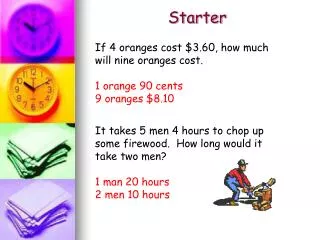
Starter If 4 oranges cost $3.60, how much will nine oranges cost. 1 orange 90 cents 9 oranges $8.10 It takes 5 men 4 hours to chop up some firewood. How long would it take two men? 1 man 20 hours 2 men 10 hours
Note 9: Significant Figures The number of significant figures a number has, is the total number of digits that represent it. Example:3147 (4 sf)
Zeros are significant when they are: • inbetween other numbers • both at the end of a number and after the decimal point • Examples: 9.703 • 7.40 (4 sf) (3 sf) • Zeros are not significant when they are: • at the front of a number • at the end of a number with no decimal point • Examples:0.036 24000 (2 sf) (2 sf)
Note 10: Rounding To round a number to a given number of decimal places/significant figures: • Underline the number of decimal place/significant figures required • Look at the next digit, if it is • less than 5, drop all numbers not underlined • 5 or more, then add one to the last digit underlined and drop all other numbers • For significant figures, zeros may be needed as place holders
Examples: 3.8194 (2 dp) 4368 (2 sf) 12.895 (2 dp) 0.0546 (1 sf) (3.82) (4400) (12.90) (0.05)
Page 25 Exercise P Page 22 Exercise N and O