"Exploring Central Europe: History, Culture, and Economy of Germany, Alpine Countries, and Poland"
This overview delves into the multifaceted history, vibrant culture, and dynamic economies of Central Europe, focusing on Germany, the Alpine countries (Austria and Switzerland), and Poland along with the Baltic nations. Discover key historical events that shaped Germany, explore Austria's rich cultural heritage and Switzerland's neutral political stance, and understand Poland's journey towards economic progress post-communism. Highlight similarities and differences in the Czech Republic, Slovakia, and Hungary's histories, and analyze how these nations are navigating contemporary challenges.

"Exploring Central Europe: History, Culture, and Economy of Germany, Alpine Countries, and Poland"
E N D
Presentation Transcript
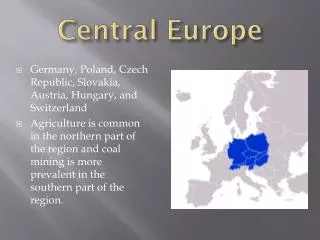
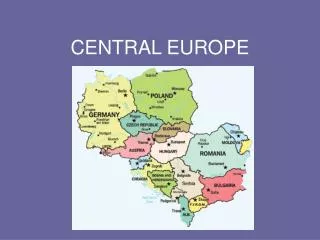
CHAPTER 15 Central Europe Section 1: Germany Section 2: The Alpine Countries Section 3: Poland and the Baltics Section 4: The Czech Republic, Slovakia, and Hungary
Section 1 Germany Objectives: • What are some key events in the history of Germany? • What are some features of German culture? • What is Germany’s economy like? • What issues and challenges does Germany face today?
Section 1 Germany Key events in German history: • Charlemagne united German kingdoms in the 700s. • Kingdoms became part of Holy Roman Empire. • Hanseatic League united northern German towns in 1300s. • Prussia and Hapsburg Empire influenced German states by 1700s. • Germany lost two world wars. • Germany divided into Communist East, democratic West. • West Germany became an economic power. • Germany united in 1990, after fall of communism.
Section 1 Germany Cultural features: • noted literature and music • Protestant majority, large Catholic minority • foods—pork, sausage, veal, cheese, pastries
Section 1 Germany Economic features: • powerful economy—fourth-largest in the world • major investors in Central Europe • manufacturing—machinery, automobiles, electronics, medical equipment • mining—coal, iron ore; Ruhr Valley a key industrial center • agriculture—efficient; grains, potatoes, sugar beets
Section 1 Germany Issues and challenges: • population—aging and immigration are changing society, causing tension • former East Germany—economy and pollution are problems; easterners resentful
Section 2 The Alpine Countries Objectives: • What are some important features of Austria’s history, culture, and economy? • What are the political, cultural, and economic features of Switzerland?
Section 2 The Alpine Countries Austria • History • part of Holy Roman Empire, then Austrian Empire, then Austro-Hungarian Empire • united with Germany in World War II • independent since 1955 • Culture • German language, Catholic religion • Vienna—key city in Central Europe; famous for architecture and music
Section 2 The Alpine Countries Austria (continued) • Economy • various industries—machinery, chemicals • forestry, hydropower, tourism, foreign trade
Section 2 The Alpine Countries Switzerland • confederation of 26 cantons • neutral—not part of UN or EU, but site of various international organizations • four major languages—German, French, Italian, Romansch • Roman Catholic and Protestant • high standard of living • international banking and insurance • chemicals, pharmaceuticals, watches, farm goods, tourism
Section 3 Poland and the Baltics Objectives: • What is the history of Poland and the Baltic countries? • What are the urban environments and economy of Poland like today? • What influences have shaped culture in the Baltic countries?
Section 3 Poland and the Baltics History of Poland: • under Russian, Austrian, and German control in 1700s and 1800s • gained independence after World War I • Communist control after World War II, for more than 40 years
Section 3 Poland and the Baltics History of the Baltics: • independence from Russia after World War I • occupied by Soviet Union during World War II • regained independence in 1991
Section 3 Poland and the Baltics Polish cities and economy: • Warsaw—capital and transport hub • Kraków—beautiful medieval city • Gdansk—main seaport and shipbuilding city • economic progress since end of communism • auto and glass factories; weak coal and steel industries • farming in loess soils—cereals, potatoes, sugar beets • unemployment a problem
Section 3 Poland and the Baltics Baltic influences: • Middle Ages—Balts in Latvia and Lithuania; Finns in Estonia • Viking and German invaders influenced Baltic culture. • Trade brought other foreign influences. • Estonia—Finnish impact on language, Lutheran religion • Latvia—ties to Sweden • Lithuania—close to Polish culture and Catholic religion • Russian minorities maintain customs.
Section 4The Czech Republic, Slovakia, and Hungary Objectives: • What are some similarities and differences in the histories of the Czech Republic, Slovakia, and Hungary? • What are the Czech Republic and Slovakia like today? • How has the fall of communism affected Hungary?
Section 4The Czech Republic, Slovakia, and Hungary Comparing histories: • Slavic peoples inhabited Czech Republic and Slovakia; non-Slavic Magyars occupied Hungary. • All three were part of Austro-Hungarian Empire. • After World War I, Czech Republic and Slovakia combined as Czechoslovakia. • Czech lands had minerals and industry; Slovakia was agricultural. • Soviets set up Communist control over both Czechoslovakia and Hungary.
Section 4The Czech Republic, Slovakia, and Hungary Czech Republic: • 40 percent Roman Catholic; similar percentage non-religious • Prague—largest city; rich heritage; modern American influence • minerals and industry—coal, iron ore, uranium; steel and glass products • farming of cereals and sugar beets • economic progress slowed in late 1990s
Section 4The Czech Republic, Slovakia, and Hungary Slovakia: • poorer country • difficult shift to capitalism; high unemployment • Bratislava—capital and largest city, on Danube River
Section 4The Czech Republic, Slovakia, and Hungary Hungary and the end of communism: • difficult change to market economy • most business privately owned • growing economy today—new industry, foreign investment, tourism • NATO member; seeking EU membership