Ch. 10 Photosynthesis
This comprehensive guide provides an overview of photosynthesis, detailing the intricate energy transfer from solar power to chemical energy via chloroplasts. It covers the net equations for photosynthesis and aerobic respiration, illustrating their interdependence. Explore the light-dependent reactions and the Calvin cycle, highlighting the roles of ATP, NADPH, and chlorophyll. The document includes important experiments, such as those by Thomas Engelmann, and practical questions to reinforce understanding. Discover how photosynthesis and cellular respiration are fundamentally opposite processes critical for life.

Ch. 10 Photosynthesis
E N D
Presentation Transcript
Ch. 10 Photosynthesis Converting Solar Energy into Chemical Energy…here we go!
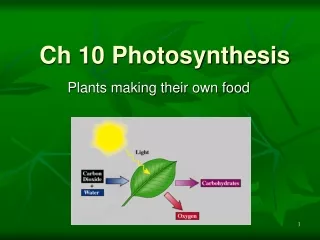
Overview of Energy Transfer Net Equation for Photosynthesis: Net Equation for Aerobic Respiration:
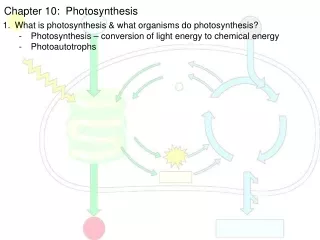
Overview of Energy Transfer solar energy Why are photosynthesis and cellular respiration often considered opposites of each other? Photosynthesis chloroplast CO2 + H2O C6H12O6 + O2 Cellular Respiration mitochondrion ATP! excess heat
Thomas Englemann Experiment Procedure: Results: Conclusion:
Thomas Englemann Experiment Procedure: Results: Conclusion:
Photosynthesis – the basics! cytoplasm H2O CO2 solar energy stroma NADP ADP 2. Calvin cycle 1. Light Reactions thylakoid membrane ATP NADPH chloroplast C6H12O6 O2
Light Reactions – the details! primary acceptor H2O e- O2 light energy e- chlorophyll photosystem I photosystem II
Light Reactions – the details! primary acceptor e- primary acceptor e- e- NADP NADP Reductase NADPH H2O light energy O2 e- light energy e- photosystem I photosystem II
Light Reactions – the details! primary acceptor e- primary acceptor e- e- NADP NADP Reductase ETC NADPH Cytochrome complex H2O ETC involved in making ATP light energy O2 e- light energy e- ATP! photosystem I photosystem II
How ATP is made in the ETC of the thylakoid membrane… stroma light energy PI PII e- e- H2O O2 thylakoid membrane
How ATP is made in the ETC of the thylakoid membrane… stroma light energy light energy PI NADP PII e- e- e- e- NADPH NADP Reductase H2O Calvin cycle O2 thylakoid membrane
How ATP is made in the ETC of the thylakoid membrane… stroma light energy light energy PI NADP PII e- e- e- e- NADPH NADP Reductase H2O Calvin cycle O2 thylakoid membrane
How ATP is made in the ETC of the thylakoid membrane… ETC becomes proton pump! H+ H+ H+ H+ Calvin cycle H+ H+ H+ H+ X ADP ATP
Some plants have adaptations in regard to photosynthesis in order to survive arid environments. Why would these adaptations be necessary?
Practice #1 • When light strikes chlorophyll molecules, they lose electrons, which are ultimately replaced by _____. A. splitting of water B. breaking down ATP C. removing them from NADPH D. fixing carbon E. oxidizing glucose
Practice #1 • When light strikes chlorophyll molecules, they lose electrons, which are ultimately replaced by _____. A. splitting of water B. breaking down ATP C. removing them from NADPH D. fixing carbon E. oxidizing glucose
Practice #2 • Which of the following is produced by the light reactions of photosynthesis and consumed by the Calvin cycle? A. sugar B. oxygen C. water D. NADPH and ATP E. ADP + Pi
Practice #2 • Which of the following is produced by the light reactions of photosynthesis and consumed by the Calvin cycle? A. sugar B. oxygen C. water D. NADPH and ATP E. ADP + Pi
Practice #3 • Carbon dioxide is utilized in photosynthesis during A. the light reactions. B. the Krebs cycle. C. the Calvin cycle. D. the electron transport chain. E. ATP synthesis.
Practice #3 • Carbon dioxide is utilized in photosynthesis during A. the light reactions. B. the Krebs cycle. C. the Calvin cycle. D. the electron transport chain. E. ATP synthesis.
Practice #4 • Which of the following is NOT a product of the light reactions of photosynthesis? A. oxygen B. sugar C. high-energy electrons D. ATP E. NADPH
Practice #4 • Which of the following is NOT a product of the light reactions of photosynthesis? A. oxygen B. sugar C. high-energy electrons D. ATP E. NADPH
Practice #5 • The overall function of the Calvin cycle is _____. A. capturing sunlight B. producing carbon dioxide C. making sugar D. oxidizing glucose E. splitting water
Practice #5 • The overall function of the Calvin cycle is _____. A. capturing sunlight B. producing carbon dioxide C. making sugar D. oxidizing glucose E. splitting water
Practice #6 • The O2 released during photosynthesis comes from A. H2O B. CO2 C. NADPH D. RuBP E. C6H12O6
Practice #6 • The O2 released during photosynthesis comes from A. H2O B. CO2 C. NADPH D. RuBP E. C6H12O6
Practice #7 • Which of the following enzymes is responsible for CO2 fixation in C3 plants? A. Succinate dehydrogenase B. Hexokinase C. Amylase D. DNA polymerase E. RuBP carboxylase
Practice #7 • Which of the following enzymes is responsible for CO2 fixation in C3 plants? A. Succinate dehydrogenase B. Hexokinase C. Amylase D. DNA polymerase E. RuBP carboxylase
Practice #8 • Which of the following is the process in which O2 is released as a by-product of oxidation-reduction reactions? A. glycolysis B. Krebs cycle (citric acid cycle) C. Calvin cycle D. Light Reactions E. chemiosmosis
Practice #8 • Which of the following is the process in which O2 is released as a by-product of oxidation-reduction reactions? A. glycolysis B. Krebs cycle (citric acid cycle) C. Calvin cycle D. Light Reactions E. chemiosmosis