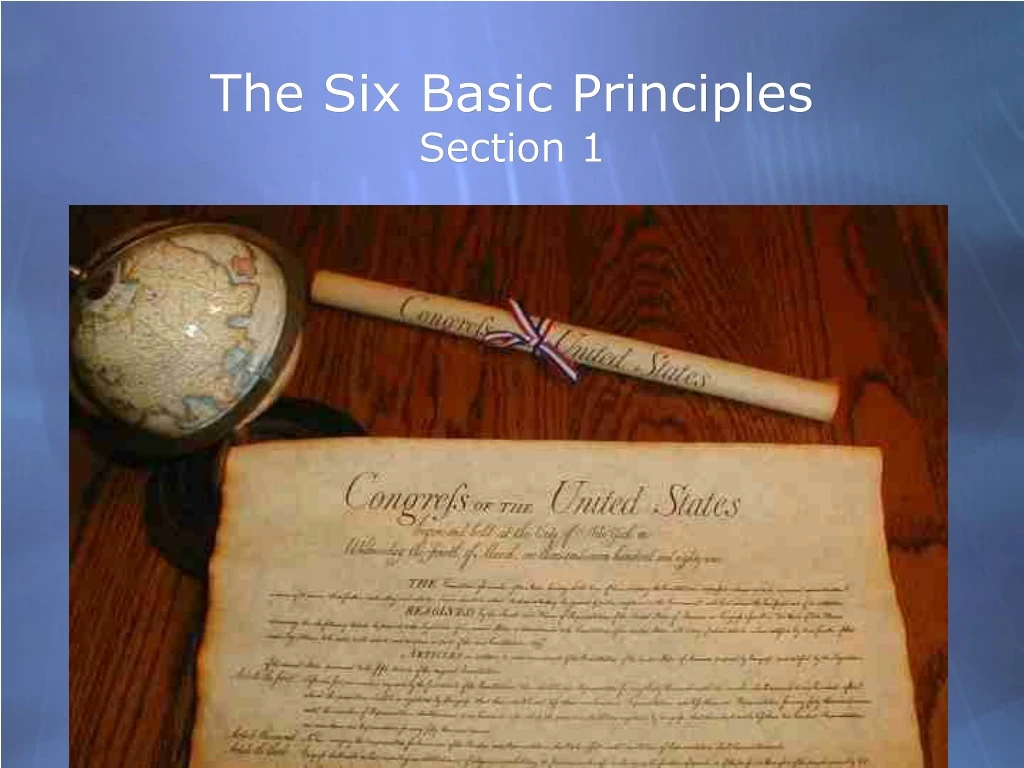

The Six Basic Principles Section 1
E N D
Presentation Transcript
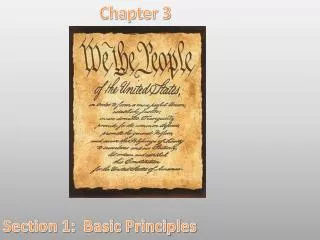
Preamble & Articles • Preamble - Introduction • - States the purpose of the constitution • Article I - Congress • Article II - Presidency • Article III - Judicial Branch • Article IV - Relations among States • Article V - Amending the Constitution • Article VI - National Debts, Supremacy of National law, Oaths of Office • Article VII - Ratifying the Constitution
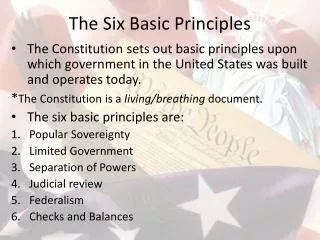
Popular Sovereignty • Government can only govern with the consent of the people. • The U.S. Government draws all of its power from the people. • The people are the only source of power
Limited Government • Government may do only those things that the people have given it the power to do. • Constitutionalism - Govt must be conducted according to constitutional principles. • Govt and its officers are subject to the rule oflaw and not above it.
Separation of Powers • Article I – Congress is the law making branch • Article II – President executes, enforces and administers law • Article III – The Supreme court interprets and applies the laws of the United States • A stronger National Government with limits on its powers.
Checks and Balances • Constitutional Checks/Restraints - Hold branches accountable to each other for actions • Examples of checks: Veto, Appointments, Court Cases • 1) Checks makes compromise necessary • 2) Keeps the government running • 3) It prevents an unjust combination of the majority. • 4) Creates a working relationship between Congress & President • Runs smoother when same political party is in control.
Judicial Review In judicial review, the court determines constitutionality of government actions. • The power to declare acts unconstitutional. • The Supreme Court answers the question: Does government act in accordance with the Constitution? • Independent judges are essential • - Protect against being swayed by society • Power was established in the case of Marbury v. Madison • Most cases govt is acting constitutionally
Federalism • Federalism is the separation of power among central government & several regional governments. • - Example: Washington DC and States • The federal arrangement is a division of powers.
Formal Amendment Section 2
4 Methods of Formal Amendment • 1. 2/3 vote in each house and ¾ of State legislatures (38) • 2. Proposed by Congress and ratified at conventions in ¾ of the States • 3. Proposed by an national convention requested by 2/3 of the States and ratified by ¾. • 4. Proposed by a national convention, and ratified by conventions in ¾ of States.
Federalism & Popular Sovereignty • Amending embodies federalism • - Proposed nationally, Ratified by States • Amendments represent the sovereign will of the people • Other details regarding amending: • States can’t amend proposals by approved vote of the people. • Article V - No State is deprived equal suffrage in the Senate.
The 27 Amendments • Since 1789 10,000 proposals made • Bill of Rights (1st 10 Amendments to Constitution) proposed 1789, ratified 1791 • 33 have been sent to the States • 27 have been ratified • There are time limit set for ratifying • - 27th Amendment ratified after 202 years but most were between 1 and 3 years. • - Supreme Court case (Dillon v. Gloss) (1921) said Congress can set reasonable time limits
The 27 Amendments • 1st Amendment • - Freedom of Religion, Speech, Press, Assembly & Petition • 2nd Amendment • - Right to Bear Arms • 3rd Amendment • - Quartering of Troops • 4th Amendment • - Search & Seizures (warrant or Prob Cause)
es • 5th Amendment • - No Double Jeopardy, No Self-Incrimination, Confront Witness, Eminent Domain • 6th Amendment • - Fair, Speedy Trial, Informed of Charges • 7th Amendment • - Civil Cases in Federal Court, Right to a Jury • 8th Amendment • - Cruel & Unusual Punishment, Excessive Bail • 9th Amendment • - Enumerated Rights (Bill of Rights are not your only rights)
l • 10th Amendment • - Powers to the State(Those not to the Fed) • 11th Amendment • - Suits against States(Can’t sue in Fed court) • 12th Amendment • - election of president and vice (separate ballots) • 13th Amendment • - slavery and involuntary servitude (abolished slavery) • 14th Amendment • -rights of citizens- citizenship at birth
15th Amendment (Civil War Amend) • - right to vote- race, color, servitude • 16th Amendment • - income tax- Congress power to tax income • 17th Amendment • - election of senators - popular vote • 18th Amendment • - prohibition of alcohol • 19th Amendment • - equal suffrage - women • 20th Amendment (Lame Duck Amendment) • - commencement of terms- January 20th,
21st Amendment - repeal of the 18th 22nd Amendment - presidential tenure- 2 terms 10yrs. 23rd Amendment - electors of D.C.- (3) 24th Amendment - eliminated any poll tax 25th Amendment - presidential succession 26th Amendment - right to vote 18yrs. 27th Amendment - congressional pay - next term
Constitutional Changes by Other Means Section 3
5 Means of Change 1. Basic Legislation • - Congress passes laws • - How is uses its powers 2. Executive Action • - In dealing with foreign affairs – President can make executive agreements with other foreign leaders • - Military actions – can use the armed forces without declaring war under power as Commander in Chief 3. Court Decisions – case decisions make changes
4. Party Practices - political parties participate in process of choosing President • - presidential appointments made considering the political parties • Custom – Unwritten rules that have become part of the procedures of government. For example, -Cabinet made of 15 departments • - Vice President takes office in Death of the President(not formal until the 25th amendment).