Cluster Phenotypes - Background
This study investigates the complexity of asthma phenotypes by utilizing cluster analysis on data from the Busselton Health Survey (2005-2007), involving 1,970 adults. We aim to uncover distinct asthma subtypes, such as eosinophilic and neutrophilic, and intermediate phenotypes related to IgE and airway hyper-responsiveness. By examining how genetic variations correlate with these clusters, the research seeks to identify novel pathways and optimize treatment strategies for asthma management. We also consider the influence of environmental exposures and questionnaire data on phenotype classification.

Cluster Phenotypes - Background
E N D
Presentation Transcript
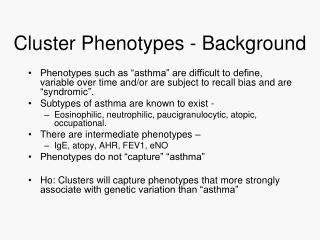
Cluster Phenotypes - Background • Phenotypes such as “asthma” are difficult to define, variable over time and/or are subject to recall bias and are “syndromic”. • Subtypes of asthma are known to exist - • Eosinophilic, neutrophilic, paucigranulocytic, atopic, occupational. • There are intermediate phenotypes – • IgE, atopy, AHR, FEV1, eNO • Phenotypes do not “capture” “asthma” • Ho: Clusters will capture phenotypes that more strongly associate with genetic variation than “asthma”
Cluster Phenotypes • Cluster Analysis (SAS) • Busselton Health Survey 2005-7 • All adults with: • Age, Sex, FEV1, FVC, eNO, eosinophil count, BMI, airway hyper-responsiveness (AHR), atopy (skin tests) • n = 1,970 • 7 clusters (each with n > 100)
Cluster Phenotypes - Questions • How many clusters? • ? Sub-clusters • What other variables to collect? • Include exposure? • Include questionnaire data? • Include treatment? • Do clusters suggest pathways? • Best gene association strategy • GWAS, candidate (from lit. or pathways)?
Excessive Airway Narrowing in a General Population n = 201 James et al. ARRD 1992;146:895-9
Smooth muscle Outer wall area Inner wall area Basement membrane perimeter Airway Compartments Lumen area
Airway smooth muscle in asthma: collaborative study James et al AJRCCM (rejected), Thorax (rejected), ERJ (submitted)
Decline in lung function - the Busselton Health Study Females James et al AJRCCM 2005;171:109
A Longitudinal Study of Childhood Asthma Followed to Adulthood FEV1/FVC Mean (SE) from 9-26 Yrs in Males and Females, by Pattern of Wheezing Sears M et al. N Engl J Med 2003;349:1414-1422
Asthma (ever) (p <0.001)* (p <0.001)* (p <0.001)* (p <0.001)* *1981 vs 2005/07 Q. “Has a doctor ever told you that you had asthma?” Q. “Have you ever had asthma?”
(p <0.001)* Wheeze (ever) (p <0.001)* (p <0.029)* *1981 vs 2005/07 Q. “Has your chest sounded wheezy on most days or nights?” Q. “Has your chest ever made a wheezing or whistling sound?”
Wheeze <12 months Recent Wheeze
Cough/Phlegm (p <0.02)* (p <0.02)* (p <0.02)* (p <0.02)* *1981 vs 2005
Bronchitis Q. “Have you ever had bronchitis? Q. “Has your doctor ever told that you had bronchitis?”