Understanding Cantwell and Chaplinsky: Speech, Punishment, and the Doctrine of Fighting Words
This analysis explores the contrasting outcomes of the Cantwell and Chaplinsky cases regarding free speech and punishment. It delves into their statements, the differing legal frameworks that apply to each, and the critical distinctions made by the Court between "offensive ideas" and "fighting words." We investigate the purpose of the fighting words doctrine, the definitions provided by the Court, and its implications for societal peace. This examination raises questions about objectivity in determining fighting words and the standards applied to individuals like Marshall Bowering compared to ordinary citizens.

Understanding Cantwell and Chaplinsky: Speech, Punishment, and the Doctrine of Fighting Words
E N D
Presentation Transcript
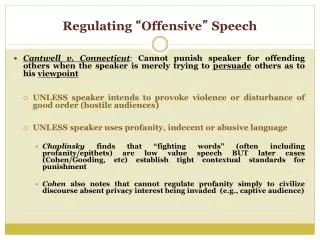
Cantwell &Chaplinsky • Why is Chaplinsky punished for his speech but Cantwell is not? • What was the result of each of their statements? • How is the content of their speech different? • How are the laws under which the are punished different? • Why does the Court distinguish between “offensive ideas” and “fighting words” – i.e., why punish the latter but not the former? • What is the purpose of the fighting words doctrine – i.e., why would we hold that it is okay to punish fighting words because they are “low value”)?
Chaplinsky& the definition of fighting words • “The test is what men of common intelligence would understand would be words likely to cause an average addressee to fight.…The English language has a number of words and expressions which by general consent are ‘fighting words’ when said without a disarming smile.…The statute, as construed, does no more than prohibit the face-to-face words plainly likely to cause a breach of the peace by the addressee, words whose speaking constitute a breach of the peace by the speaker—including ‘classical fighting words’, words in current use less ‘classical’ but equally likely to cause violence, and other disorderly words, including profanity, obscenity and threats.” (p. 85) • Is this an objective or contextual test? • Is there such a thing as “objectively-determinable” fighting words? • What problems arise with using an objective test? • Should Marshall Bowering be held to a higher standard than ordinary citizens?