Advanced Modeling Techniques for Species Distribution: A Case Study on *Lobo Guara* and *Furcata Boliviana*
90 likes | 212 Vues
This study applies various algorithms, including Distance to Average, DG_GARP_BS, Bioclimatic Envelopes, and Climate Space Model-Broken Stick, to construct predictive distribution models for the species *Lobo Guara* and *Furcata Boliviana*. Important parameters such as maximum distance, commission thresholds, and training proportions were carefully selected to enhance model reliability. This research contributes to understanding habitat preferences and climate adaptations of these species, providing valuable insights for conservation efforts.


Advanced Modeling Techniques for Species Distribution: A Case Study on *Lobo Guara* and *Furcata Boliviana*
E N D
Presentation Transcript
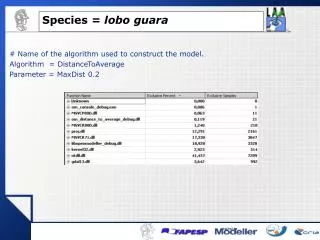
Species = lobo guara # Name of the algorithm used to construct the model. Algorithm = DistanceToAverage Parameter = MaxDist 0.2
Species = lobo guara # Name of the algorithm used to construct the model. Algorithm = DG_GARP_BS Parameter = CommissionSampleSize 10000 Parameter = CommissionThreshold 50 Parameter = ConvergenceLimit 0.01 Parameter = HardOmissionThreshold 100 Parameter = MaxGenerations 400 Parameter = MaxThreads 1 Parameter = ModelsUnderOmissionThreshold 20 Parameter = PopulationSize 50 Parameter = Resamples 2500 Parameter = TotalRuns 100 Parameter = TrainingProportion 0.5
Species = furcata boliviana #Minimum distance Algorithm = MinimumDistance Parameter = MaxDist 0.1
Species = furcata boliviana #Bioclimatic Envelop Algorithm = Bioclim Parameter = StandadDeviationCutoff 0.674
Species = furcata boliviana #Bioclimatic Envelop using distance to average Algorithm = Bioclim Distance Parameter = StandadDeviationCutoff 0.674
Species = furcata boliviana # Climate Space Model - Broken-Stick Algorithm = CSMBS Parameter = Randomisations 8 Parameter = RandomiserRepeats 50 Parameter = StandardDeviations 0.05 Parameter = MinComponents 2 Parameter = MaxAttempts 1
Species = furcata boliviana # GARP: Genetic Algorithm for Rule Set Production Algorithm = GARP Parameter = MaxGenerations 100 Parameter = ConvergenceLimit 0.05 Parameter = Resamples 2500 Parameter = MutationRate 0.25 Parameter = CrossoverRate 0.25
Species = furcata boliviana # GARP with Best Subsets Procedure Algorithm = GARP_BS Parameter = TrainingProportion 0.5 Parameter = TotalRuns 10 Parameter = HardOmissionThreshold 100 Parameter = ModelsUnderOmissionThreshold 20 Parameter = CommissionThreshold 50 Parameter = CommissionSampleSize 10000 Parameter = MaxThreads 5 Parameter = MaxGenerations 20 Parameter = ConvergenceLimit 0.05 Parameter = PopulationSize 50 Parameter = Resamples 2500 Parameter = MutationRate 0.25 Parameter = CrossoverRate 0.25
Species = furcata boliviana # Distance to average Algorithm = DistanceToAverage Parameter = MaxDist 0.1