Download
1 / 16
160 likes | 338 Vues
In this lesson, we explore polar equations of conics, focusing on eccentricity and how it relates to the type of conic defined. Learn to write polar equations for various conics such as ellipses, parabolas, and hyperbolas using the relationship between focus and directrix. We will revisit orbits and understand why astronomers utilize this approach. The lesson will provide a clear framework for analyzing these equations, ensuring a solid grasp of conic sections in the polar plane.

E N D
Precalculus Lesson 8.5 Polar Equations of Conics
What you’ll learn about • Eccentricity Revisited • Writing Polar Equations for Conics • Analyzing Polar Equations of Conics • Orbits Revisited … and why You will learn the approach to conics used by astronomers.
Focus-Directrix Definition Conic Section A conic section is the set of all points in a plane whose distances from a particular point (the focus) and a particular line (the directrix) in the plane have a constant ratio. (We assume that the focus does not lie on the directrix.)
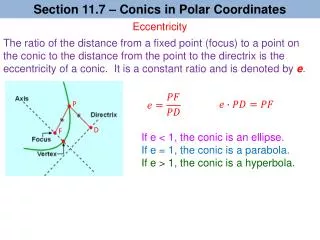
Focus-Directrix Eccentricity Relationship If Pis a point of a conic section, F is the conic’s focus, and D is the point of the directrix closest to P, then where e is a constant and the eccentricity of the conic. Moreover, the conic is a hyperbola if e > 1, a parabola if e = 1, an ellipse if e < 1.
Three Types of Conics for r = ke/(1+ecosθ) Directrix Directrix Directrix P D P D P D F(0,0) F(0,0) F(0,0) x = k x = k x = k Parabola Ellipse Hyperbola
Polar Equations for Conics Two standard orientations of a conic in the polar plane are as follows. Focus at pole Focus at pole Directrixx = k Directrixx = k
Polar Equations for Conics The other two standard orientations of a conic in the polar plane are as follows. Directrixy = k Focus at pole Focus at pole Directrixy = k
Example Identifying Conics from Their Polar Equations Note, the sign in the denominator dictates the sign of the directrix.
Homework: Text pg683 Exercises # 4-40 (intervals of 4)