Understanding Artificial Intelligence: Definitions, Concepts, and Methodologies
This introduction to Artificial Intelligence (AI) explores its definition as a branch of computer science focused on automating intelligent behavior. It discusses the relationship between intelligence, creativity, and intuition, raising ethical questions about machine intelligence. The course delves into various methods to model intelligence, including mathematical logic, connectionist networks, and social systems. Key AI sub-disciplines like machine learning, natural language processing, and robotics are examined, emphasizing the challenges of mimicking human intelligence and utilizing inexact information.

Understanding Artificial Intelligence: Definitions, Concepts, and Methodologies
E N D
Presentation Transcript
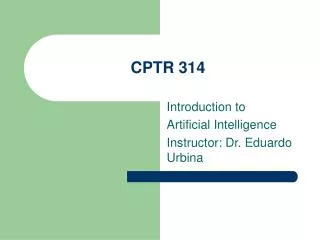
CPTR 314 Introduction to Artificial Intelligence Instructor: Dr. Eduardo Urbina
Artificial Intelligence Definition • AI may be defined as the branch of computer science that is concerned with the automation of intelligent behavior • Artificial Intelligence uses the techniques of Computer Science • Data Structures for knowledge representation • Programming Languages & Techniques • Algorithms
What is Intelligence? • Does it mean to perform operations fast? • Is it learned? • What is the relationship with intuition? • What is the relationship with creativity? • Can machines be intelligent? If so, Is it morally correct? Can only God create intelligence?
Definition • AI is the collection of problems and methodologies studied by artificial intelligence researchers
How can you model Intelligence? • Mathematical logic • Main technique so far • Connectionist Networks • De-emphasizes logic and the functioning of the rational mind but concentrates in the architecture of the physical mind
How do we model Intelligence? • Using artificial life and genetic algorithms • Applies the principles of biological evolution to the problems of finding solutions to difficult problems • Solutions are are found by analyzing competing solutions; solutions with promise will tend to survive
How do we model Intelligence? • Social systems provide another metaphor for intelligence; the basis of this are agents • An agent is an element of a society that can perceive aspects of its environment and affect that environment either directly or through cooperation with other agents
Agents Characteristics • Agents are autonomous or semi-autonomous • Each agent has little or no knowledge of what other agents do or how they do things • Agents are sensitive to their own surroundings • Agents are interactional; they cooperate on a particular task • Intelligence is the result of the society as a whole not just a property of an individual agent
Overview of AI • Most fundamental concerns of AI researchers are • Knowledge representation and search • Machine learning
AI is Complex • Mimicing human intelligence is hard • Use of symbolic reasoning • Humans use inexact, missing or poorly defined information; they rely on intuition. • Answers may not be exact or optimal but just sufficient to solve a problem
Game Playing Automated Reasoning and Theorem Proving Expert Systems Natural Language Robotics Languages and Environments Machine Learning Parallel Distributed Processing Modeling Human Performance AI Sub-disciplines
AI features • Use of computers to do symbolic reasoning, pattern recognition, learning, or some other form of inference • A focus of problems that do not respond to algorithmic solutions • A concern with problem solving using inexact, missing, or poorly defined information • Provide answers that are neither exact nor optimal, but in some sense “sufficient”