Explore Density: Sink or Float? Density Calculation with Water Displacement Method
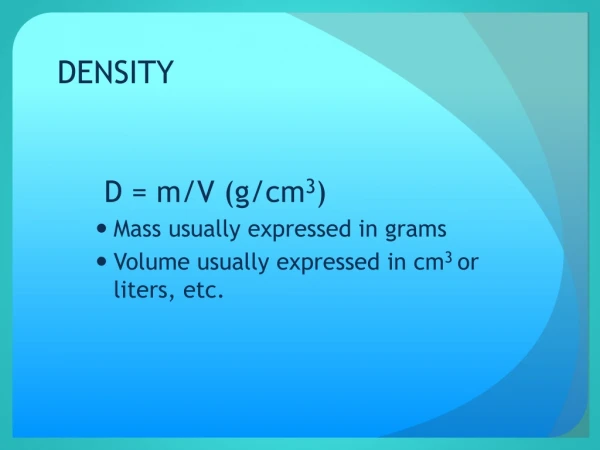
This educational activity engages students in understanding density through the water displacement method. An object is submerged in a graduated cylinder containing 20 mL of water, causing the water level to rise. By measuring the new water level at 43 mL, students calculate the object's volume to be 23 mL. With the object's mass measured at 373.3 g, they use the formula for density (D = M/V) to find that the density is 16.23 g/mL. This hands-on experiment fosters critical thinking and solidifies concepts related to buoyancy and matter.


Explore Density: Sink or Float? Density Calculation with Water Displacement Method
E N D
Presentation Transcript
Sink or Float? Density #3 R. Bryant 2008 WSMS – Based on “Science Starters” by T. Trimpe at http://sciencespot.net
Find the density of the object below. An object was dropped into a graduated cylinder that contained 20 mL. Determine the volume of that object. The object was placed on a triple beam balance. The mass Image from http://ritter.tea.state.tx.us/ Image from http://genchem.rutgers.edu/bal3b2.html
The solution … Volume = Volume of water & object – volume of water Volume = 43 mL – 20 mL V = 23 mL M = 373.3 g Density = Mass ÷ Volume D = 373.3 g ÷ 23 mL D = 16.23 g/mL