
Analyzing Temporal Relationships in Ankle Angle During Walking: A Nonlinear Approach
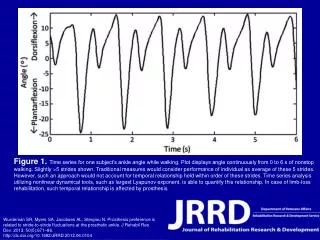
This study presents a time series analysis of a subject's ankle angle while walking continuously for 6 seconds, showcasing over 5 strides. Traditional performance measures might yield an average of these strides, neglecting the essential temporal relationships intrinsic to their order. We employ nonlinear dynamical tools, such as the largest Lyapunov exponent, to quantify these relationships, especially important in limb-loss rehabilitation, where prosthetic influence is a factor. We reference work by Wurdeman et al. on the connection between prosthesis preference and stride fluctuations at the prosthetic ankle.

Analyzing Temporal Relationships in Ankle Angle During Walking: A Nonlinear Approach
E N D
Presentation Transcript
Figure 1. Time series for one subject’s ankle angle while walking. Plot displays angle continuously from 0 to 6 s of nonstop walking. Slightly >5 strides shown. Traditional measures would consider performance of individual as average of these 5 strides. However, such an approach would not account for temporal relationship held within order of these strides. Time series analysis utilizing nonlinear dynamical tools, such as largest Lyapunov exponent, is able to quantify this relationship. In case of limb-loss rehabilitation, such temporal relationship is affected by prosthesis. Wurdeman SR, Myers SA, Jacobsen AL, Stergiou N. Prosthesis preference is related to stride-to-stride fluctuations at the prosthetic ankle. J Rehabil Res Dev. 2013; 50(5):671–86. http://dx.doi.org/10.1682/JRRD.2012.06.0104