The Fascinating History and Mechanics of the Crossbow
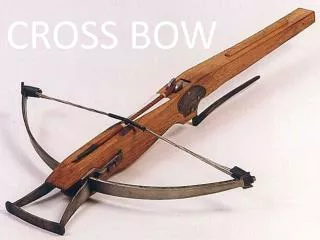
The crossbow, an ancient weapon predating firearms, continues to be utilized in hunting today. Originating in China around 2000 B.C., its historical significance is evident, with early depictions found in graves. Introduced to Europe by 400 B.C., the crossbow has evolved over centuries. This powerful weapon features a straightforward mechanism that allows for accurate shooting. Learn how to construct a crossbow using basic materials, and understand its role as a pivotal weapon in historical Chinese battles before its enhancements in the China-Japan War of 1895.

The Fascinating History and Mechanics of the Crossbow
E N D
Presentation Transcript
History • The cross bow has been around longer than guns, and is still used today by hunters. Historians can tell the Chinese invented them because they appear on their grave. The cross bow is a popular weapon of wookies (creature from Star Wars) and vampire slayers. Historians believe the cross bow was made around 2000 B.C. The cross bow was introduced to Europe around 400 B.C.
How It Works • The cross bow is simple. When put the bow in it will be by the end of a string. You will put the string in a hook. When you pull the trigger it will release the sting pushing the bow forward.
How to Make a Cross Bow • Materials- • You will want to cut the pole in for parts, 3 even length, 1 bigger. Hot glue them so the big one and a small are in a T position. Glue the other two on the small stick so they stick up at a 90˚ angle. Then glue the cloths pin on the long string (make it close enough for the rubber band to be able to reach it). Then put the rubber around the two sticks. How to Shoot it Pull the rubber band back and put it in the cloths pin. Balance the pencil on the long stick and open the cloths pin.
Why was the Cross Bow Made? • The cross bow was made as a primary weapon in Chinese battles. Once China invented the cross bow Rome tried to improve it. The weapon was not very powerful or accurate until 1895 in the China-Japan War.