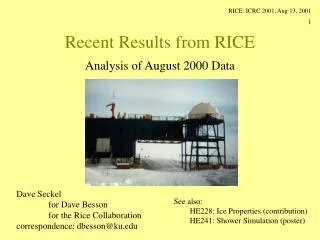
Recent Results from RICE: Analysis of August 2000 Data at ICRC 2001
350 likes | 461 Vues
The talk presents preliminary results from the Radio Ice Cerenkov Experiment (RICE) based on data collected in August 2000. It covers the project's goals, including the detection of high-energy neutrinos from astrophysical sources. The presentation discusses deployment status, event rate calculations, interaction rates, detector efficiency and calibration, signal simulation, data acquisition, and analysis methods. Notable findings include preliminary flux limits and insights into shower simulations. This work contributes significantly to understanding neutrino detection and the characteristics of events in the deep ice.


Recent Results from RICE: Analysis of August 2000 Data at ICRC 2001
E N D
Presentation Transcript
RICE: ICRC 2001, Aug 13, 2001 Recent Results from RICE Analysis of August 2000 Data Dave Seckel for Dave Besson for the Rice Collaboration correspondence: dbesson@ku.edu • See also: • HE228: Ice Properties (contribution) • HE241: Shower Simulation (poster)
RICE: ICRC 2001, Aug 13, 2001 OUTLINE • Concept • Deployment Status • Event Rate Calculation • Interaction rate • Detector efficiency and calibration • Simulation of signal generation • Propagation • Data Acquisition • Analysis • Preliminary ne flux limit from Aug 2000 • Summary
RICE: ICRC 2001, Aug 13, 2001 Radio Detection of High Energy Neutrinos Goals PeV: AGN 1 km3 EeV: GZK 103 km3 Coherent radiation S ~ DQ ~ 0.25 Es/GeV l ~ RM ~ 10 cm Transparency > 1 km Thermal noise @ 250 k
RICE: ICRC 2001, Aug 13, 2001 Deployment Status Pole: • 16 Rx (10 cm dipole) • 5 Tx • 3 Horns • 4 Oscilliscopes (x4) • DAQ • PCs • Pulse Generator • Dry hole Kansas: • Network analyzer • Antenna range
RICE: ICRC 2001, Aug 13, 2001 Single Channel Power Filter Amp cable Amp in PV Splitter Scope Trigger generator PC Antenna
RICE: ICRC 2001, Aug 13, 2001 Sample Trigger (surface event) Spectrum Time domain
RICE: ICRC 2001, Aug 13, 2001 Event Rates for RICE • G is interaction rate to create a shower • e is detection efficiency
RICE: ICRC 2001, Aug 13, 2001 G – interaction rate to create showers • function of energy, direction and position • f is local, after propagation through the Earth • models for s may vary up to 50%
RICE: ICRC 2001, Aug 13, 2001 e - shower detection efficiency Monte Carlo Simulation + Calibration • Several unique features to RICE • Shower simulation + EM pulse calculation • Pulse propagation • Data acquisition and trigger • Offline analysis
RICE: ICRC 2001, Aug 13, 2001 Shower simulations (see HE 241) • ZHS • GEANT • FLUKA Number of particles & track length differ 30% Is this good or bad ?
RICE: ICRC 2001, Aug 13, 2001 EM pulse (see HE 241) • Angular distribution OK • Spectra differ slightly • All differences from shower Experimental results (Saltzberg, et al.) confirm coherence and Askaryan effect
RICE: ICRC 2001, Aug 13, 2001 Tx locations from timing residuals
RICE: ICRC 2001, Aug 13, 2001 Propagation (read HE 228) • Index of refraction • Absorption Simultaneous fit to Rx, Tx positions and n(z)
Power Filter Amp cable Amp in PV Splitter Scope Trigger generator PC Antenna RICE: ICRC 2001, Aug 13, 2001 DAQ: Antenna to trigger
RICE: ICRC 2001, Aug 13, 2001 Antenna calibration Measure ZA, h, (q, y) dependence Antenna Range
RICE: ICRC 2001, Aug 13, 2001 Amplifer Gains • 14/3/2001 - 16/3/2001: 200 forced triggers w/thermal noise • Isolate deep and surface Amps using filter • Since 1/1/2001: stable +/- 1 dB
RICE: ICRC 2001, Aug 13, 2001 Individual channel calibration HP8713C NWA 0-1000 MHz 200-500 MHz: +/- 6 dB • antenna + amplifier calibrations • cable (TX, RX) and filter • relative geometry of TX/RX (r, q)
RICE: ICRC 2001, Aug 13, 2001 Pulse Shapes Model response for d-function impulse Rx response for square wave pulse
RICE: ICRC 2001, Aug 13, 2001 Trigger logic
RICE: ICRC 2001, Aug 13, 2001 Effective Volume Ideal 1 hit, 1 s, l GHz 1 km3 @ 100 PeV RICE 2000 4 hits (hardware)
RICE: ICRC 2001, Aug 13, 2001 Offline Analysis From waveforms Also: acceptable c2 for vertex, and vertex below -50 m. Cuts pass ~85% of events in MC.
RICE: ICRC 2001, Aug 13, 2001 Model Flux Limits
RICE: ICRC 2001, Aug 13, 2001 Power Law Flux Limits
RICE: ICRC 2001, Aug 13, 2001 Summary • Too many Dave’s • Many calibration steps – many unique to RICE • Could still be improved – but a number in every box • 1 km3 @ 100 PeV • Flux limits about 100 above optimistic models • (less than one month data) • RICE-2 (bigger V, lower E - AGN) • and RICE-3 (1000 km3 @ 1 EeV - GZK)
RICE: ICRC 2001, Aug 13, 2001 Tests for Figures
RICE: ICRC 2001, Aug 13, 2001 RICE: Radio Ice Cerenkov Experiment Canterbury: • J. Adams, S. Seunarine Delaware: • D. Seckel, G. M. Spiczak Florida State: • G. Frichter Kansas: • C. Allen, A. Bean, D. Besson, D. J. Box, R. Buniy, E. Copple, D. McKay, J. Ralston, S. Razzaque, D. W. Schmitz M.I.T.: • I. Kravchenko correspondence: dbesson@ku.edu
Equations RICE: ICRC 2001, Aug 13, 2001
RICE: ICRC 2001, Aug 13, 2001 Single channel spectral response HP8713C NWA 0-1000 MHz • antenna + amplifier calibrations • cable (TX, RX) and filter • relative geometry of TX/RX (r, q)
RICE: ICRC 2001, Aug 13, 2001 Signal Strength
RICE: ICRC 2001, Aug 13, 2001 Spectrum