Download
1 / 13
130 likes | 246 Vues
Explore the essential concepts of standard and metric measurements with this comprehensive guide. Discover how to convert units of length, weight, and capacity effortlessly, using factors like inches, feet, pounds, and gallons in standard measurements, and kilometers, grams, and liters in metric measurements. Learn about metric prefixes and how to utilize the cancellation method for effective unit conversion. Engage with practical examples, from fashion design to cooking, ensuring you understand how to apply these conversion skills in real-life scenarios.

E N D
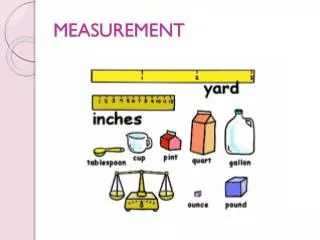
(Standard)Measurements of Length • 1 ft = • 1 yd = ft = in • 1 mi = ft = yd
(Standard)Measurements of Weight • 1 lb = oz • 1 T = lb
(Standard) Measurements of Capacity (Volume) • 1 c = fl oz • 1 pt = c = fl oz • 1 qt = pt = c • 1 gal = qt = pt = c
Metric Measurements • Length = • Mass (weight) = • Capacity (volume) =
Metric Prefixes kilo- 1000 hecto- 100 deka- 10 1 deci- 0.1 centi- 0.01 milli- 0.001 multiply by 10 divide by 10
Unit Conversions • Use the cancellation method:
Example 1 • Find the equivalent measurements: • 13,236 inches = ? miles • 2.34 kiloliters = ? milliliters
Find the equivalent measurements: • 2 gal = ? fl oz • 4,650 oz = ? lb • 250 cm = ? m • 15 g = ? mg
Example 2 • A clothing designer needs 1 yd 2 ft of material for a pair of pants. For the coordinating shirt, 2 ft 6 in of material are needed. The material is measured in inches. How much material does the designer need for the entire outfit?
Example 3 • You use 2 kg of ground beef to make 20 hamburgers. How many grams does each hamburger weigh?
Example 4 • To make punch, you use 6 quarts of pineapple juice, 7 quarts of lemon-lime soda, and 1 quart of orange juice. How many cups of punch are made?
Homework • Purple Book • p. 47-48: 1-20 all