The Nullification Crisis and the Bank War: Tensions Between North and South in Early America
110 likes | 248 Vues
The Nullification Crisis and Bank War epitomized early 19th-century tensions in America, highlighting the economic and political rifts between the North and South. President Andrew Jackson faced challenges after the "Corrupt Bargain" of 1824 between John Quincy Adams and Henry Clay. The 1828 Tariff, seen as onerous by Southern states, spurred South Carolina's nullification efforts and threats of secession. Concurrently, the Bank War underscored Jackson's opposition to the Bank of the United States, culminating in a major economic crisis in 1837.


The Nullification Crisis and the Bank War: Tensions Between North and South in Early America
E N D
Presentation Transcript
The Corrupt Bargain (1824) • Pres. Election AJ vs. J.Q. Adams • Tied electoral college vote • Speaker of House decides (Henry Clay) • Clay gave his votes to J.Q. Adams • Clay became Sec. of State • AJ got majority of people’s votes, but not elected POTUS • “Corrupt Bargain”
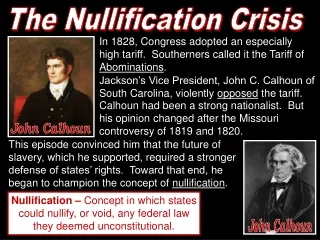
Protective Tariff • Unpopular in South • Increased prices on manufactured goods with no real benefits • Protected Northern jobs, but no manufacturing in South • North getting rich at the expense of the South • Tariff of 1828 (Tariff of Abominations) raised tariffs 2x!!
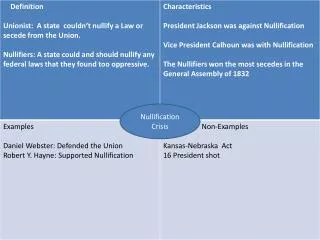
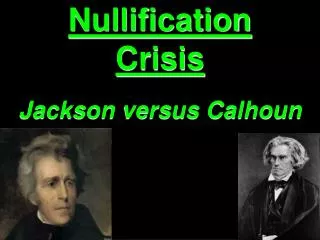
Southern Reaction • Some in South Carolina talked of secession • John Calhoun (AJ’s VP) from S.C. • Wrote on attacking the Tariff • Calhoun said states had a right to nullify a federal law (thought the threat would lower the tariff) • What is this called? What context have you seen it before?
1832, new higher tariff put in place • S.C. voted to nullify the tariff on 1830 & 1832 • Only state that did this • AJ livid! • Congress passed Force Bill • Allowed POTUS to do anything necessary to enforce federal laws • Could send army/navy to S.C. if didn’t pay duties • A.J. sent a warship to Charleston • Violence pending!
Clay came through to save the day! • Convinced Congress to pass a compromise tariff: If S.C. repealed nullification, Congress would lower the tariff rate • S.C. agreed to save their butts from going to war • The nullification crisis symbolized increased tension between the North and South • What types of tension were there? • Economic, political power, slavery…forshadowing?
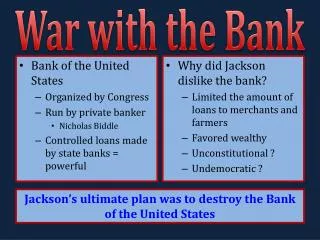
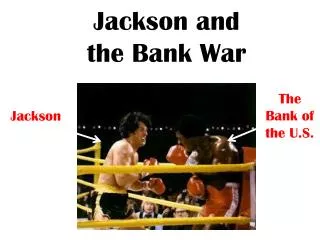
The Bank War • How did the Democrats and AJ feel about the BUS? • Favored the elite and wealthy • Obstacle to the common man, prevented smaller banks from loaning more money to more people • BUS set to expire 1836 • Director of BUS (Nicholas Biddle) began granting favors (cheap loans) to politicians to insure a renewal despite AJ’s objections
Clay vs. AJ • Election of 1832: Clay vs. AJ • Clay pushed a charter (renewal) bill through Congress (big campaign issue) • AJ won over Clay in election • Removed federal funds from BUS (no $, no BUS) and deposited money in state banks he liked (“pet banks”)
Biddle’s Response • Needed loans to make sure BUS had $ to operate • Hoped Congress would override AJ’s veto • Recession, eventually led to bankruptcy 1836 • The Bank War and the end of the BUS led to the Panic of 1837 (economic depression)