
Understanding Primitive Recursive Functions and Their Turing Machine Equivalents

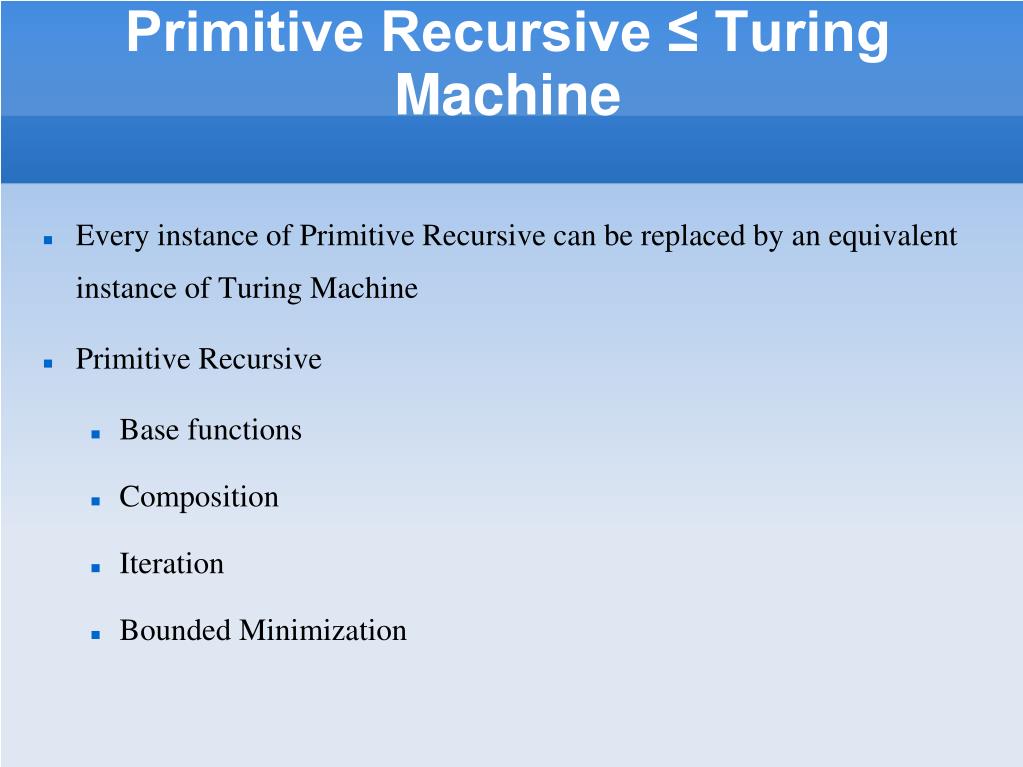
This resource delves into the relationship between Primitive Recursive Functions (PRF) and Turing Machines (TM), establishing that every instance of PRF can be effectively represented as an equivalent Turing Machine instance. It details the foundational concepts like base functions, composition, iteration, and bounded minimization. The capabilities of TMs in handling n-ary functions through Turing computations are explained, using formal definitions and operations of base machines and submachines. This work provides valuable insights into computability theory and the transition between different computational models.
Télécharger la présentation 
Politique de téléchargement : le contenu du site vous est fourni TEL QUEL pour votre information et votre usage personnel ; il ne peut être vendu, concédé sous licence ni partagé sur d’autres sites sans l’accord de son auteur.Le contenu vous est fourni TEL QUEL, pour votre information et votre usage personnel uniquement. Téléchargez la présentation en cliquant sur ce lien. Lors du téléchargement, si vous ne parvenez pas à télécharger une présentation, l’éditeur a peut-être supprimé le fichier de son serveur.Pendant le téléchargement, si vous ne parvenez pas à obtenir une présentation, le fichier a peut-être été supprimé par l’éditeur.
F I N