Effects, Structures, and Legalization of Mind-Altering Drugs: LSD, Mescaline, Psilocybin, and THC
This article explores the effects of key mind-altering substances including LSD, mescaline, psilocybin, and THC. It details LSD as a potent hallucinogen with complex mood effects, mescaline’s subjective hallucinations, and THC's milder experiences. Additionally, it examines the structural similarities and differences among these drugs, highlighting their chemical compositions. Finally, the article discusses the ongoing debate surrounding the legalization of cannabis, weighing its cultural, medical, and potential societal impacts against concerns about irresponsibility and dependence.

Effects, Structures, and Legalization of Mind-Altering Drugs: LSD, Mescaline, Psilocybin, and THC
E N D
Presentation Transcript
Mind-Altering Drugs by: Stephanie Woshner
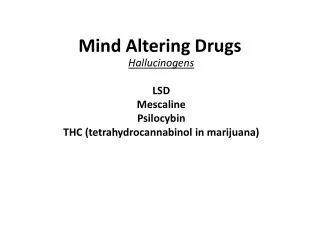
D.10.1 Describe the effects of lysergic acid diethylaminde (lsd), mescaline, psilocybin and tetrahydrocannavinol (thc). • LSD • Potent hallucinogen that creates distortions of the body and crawling geometric patterns • Causes impaired judgment, hypertension, dilated pupils, and changes to body temperature and heart rate • Can cause unpredictable mood swings from euphoria (a ‘good trip’) to depression and panic (a ‘bad trip’) • Mescaline • About 1000-3000 times less potent than LSD; causes subjective hallucinations dependent on the individual • Effects include anxiety, static tremors, and psychic disturbances and vivid visual hallucinations • THC • Produces subjective hallucinations similar to mescaline but milder • Some people experience a pleasant mood, others become apprehensive • Compulsive movement and inappropriate laughter may occur; also vertigo and dizziness • Numbness, muscle weakness and drowsiness are also common
D.10.2 Discuss the structural similarities and differences between lsd, mescaline and psilocybin. • LSD • Benzene ring • Alkene (2) • Secondary amine • Tertiary amine • Tertiary amide • Mescaline • Benzene ring • Primary amine • Ether (3) • Psilocybin • Benzene ring • Secandary amine • Tertiary amine ion • Phosphate
D.10.3 Discuss the arguments for and against the legalization of cannabis. • Used for many religious ‘ceremonies’ • Most commonly used illegal drug • Argued that it can cause irresponsibility • Argued to cause use of more addictive drugs • Used worldwide for medical purposes • Late stages of cancer • AIDS