Understanding Unit Systems in Engineering: CGS, MKS, and British Systems
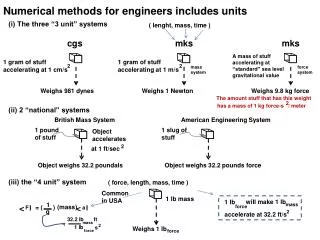
This article delves into the various unit systems used in engineering, focusing on CGS (centimeter-gram-second), MKS (meter-kilogram-second), and the British system. It explains the relationships between mass, force, and acceleration, including units like dynes, Newtons, and poundals. Examples are provided, detailing how these concepts apply to practical engineering problems, such as calculating forces in different unit systems. It emphasizes the importance of unit consistency in engineering calculations to avoid confusion and enhance accuracy.

Understanding Unit Systems in Engineering: CGS, MKS, and British Systems
E N D
Presentation Transcript
Numerical methods for engineers includes units < < (i) The three “3 unit” systems ( lenght, mass, time ) cgs mks mks A mass of stuff accelerating at “standard” sea level gravitational value 1 gram of stuff accelerating at 1 cm/s 1 gram of stuff accelerating at 1 m/s 2 2 mass system force system Weighs 981 dynes Weighs 1 Newton Weighs 9.8 kg force The amount stuff that has this weight (ii) 2 “national” systems British Mass System American Engineering System 2 has a mass of 1 kg force-s / meter 1 pound of stuff 1 slug of stuff Object accelerates 2 s 2 at 1 ft/sec Object weighs 32.2 poundals Object weighs 32.2 pounds force a F (iii) the “4 unit” system ( force, length, mass, time ) Common in USA 1 lb mass (mass) = ( ) 1 lb 1 force g Weighs 1 lb force 1 lb 2 force accelerate at 32.2 ft/s 32.2 lb ft will make 1 lb mass mass
Example using 4 unit system water tower is in Tampa < < < < < < Pressure difference (top to bottom) acceleration = water density Z P P P Z = 100 ft g P = c Not typical pressure units but they are still pressure units. lb lb lb ft 2 mass mass force 2 (2,020 x 10 ) = (62.4 ) ( 10 ft) 2 s ( 32.2 ) 3 ft 2 10 ft 1 (force magnitude) ( ) = (mass) ( ) (a)(ft ) mass = ( ) 2 lb lb 3 ft s ft mass mass = ( ) (mass) 62.4 lb 62.4 lb mass force 2 32.2 ft Since mass is in 2 the force is = 62.4 x10 3 3 (mass) 2 2 2 2 2 2 ( ) = (2,020 x 10 ) 1 ft 1 ft s s s s s s 1 2 ft s Note: The “4 unit” system entertains two density concepts. F a F a F a = (mass) g conversion factor between lb and lb 2 ft force mass 1 g g = lb force Both look the same (have units of pounds per foot cubed) but each represents a different concept. force density mass density 1 lb 1 lb 1 lb 1 lb 1 lb force force force force force 32.2 lb 32.2 lb 32.2 lb 32.2 lb 32.2 lb ft ft ft ft ft mass mass mass mass mass