
Understanding Cyclones: Nature's Powerful Storms
Cyclones are massive storms characterized by swirling winds and low atmospheric pressure. Found in regions like Northern Australia, Southeast Asia, and the Pacific Islands, these formidable weather phenomena can lead to severe damage, causing buildings to collapse, uprooting trees and power lines, and flooding low-lying areas. To stay safe during a cyclone, it’s crucial to recognize its dangers and follow safety measures, such as getting to higher ground. Learn about the fascinating nature and impact of cyclones and how they continue to affect areas long after their passage.

Understanding Cyclones: Nature's Powerful Storms
E N D
Presentation Transcript
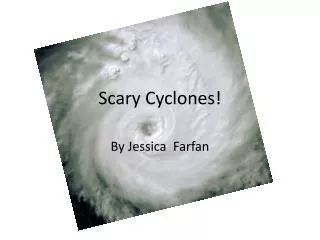
Scary Cyclones! By Jessica Farfan
What Is A Cyclone? • Cyclones are huge revolving storms caused by winds blowing a central area of a low atmospheric pressure.
Where will we find this type of weather? • Northern Australia • Southeast Asia • Pacific Islands
What kind of damage can this weather do? • Cause buildings to collapse. • Easily topple fence , sheds, trees, power poles and caravans while hurling people through the air. • Flooding low-lying coastal areas. • The water of a storm surge rushes inland with deadly power, flooding low-lying coastal areas.
Here is how you stay safe when a cyclone hits • Climb on a roof. • Hold on to something really tall.
Describe at least three interesting facts about this type of weather • Cyclones begin in tropical regions. • Long after a cyclone has passed road and rail train sport can still be blocked by floodwaters. • The swirling winds rotate faster and faster forming a huge circle witch can be up to 2,000 km across
Sources • Cosgrove, Brian. Eyewitness Weather. New York, NY: Ed Brotak, 2004 • http://library.thinkquest.org/10136/cyclones/cycltq.htm
