Understanding Insurance: Types, Purposes, and Key Concepts in Property & Personal Coverage
This introduction to insurance explores the essential distinctions between real and personal property, focusing on types of insurance and their purposes. Real property involves land and structures, while personal property includes movable and intangible items. Key concepts covered include insurance policies, premiums, proceeds, and beneficiaries. Special emphasis is placed on various types of insurance such as property, automobile, homeowner’s, life, health, and disability insurance. Understanding these fundamentals is crucial for protecting individuals and businesses against losses through risk management.

Understanding Insurance: Types, Purposes, and Key Concepts in Property & Personal Coverage
E N D
Presentation Transcript
Insurance Introduction to Business and Marketing
Today’s Objectives • Distinguish between real and personal property. • Identify the purposes and major types of insurance
Real Property • The ground and everything permanently attached to it • Includes buildings, fences, trees, soil, rocks, minerals, etc.
Personal Property • Everything other than real property that can be owned • Includes moveable objects and intangible property
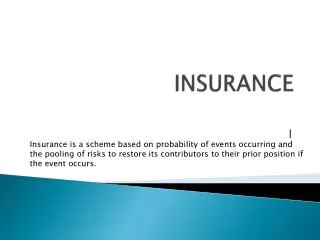
Types of Insurance Insurance is an agreement in which one party (insurer) compensates another party (insured) for any losses. Purpose – protect individuals and businesses against losses by spreading the risks of loss among a large number of people
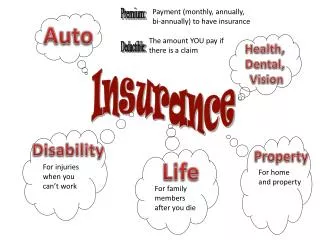
Insurance Basics • Insurance Policy – written contract between the buyer of insurance (insured / policy holder) and the insurance company (insurer) • Premium – amount of money the policyholder pays for insurance coverage; usually a monthly fee • Proceeds – payments by the insurer for losses covered in a policy • Beneficiary – person named to receive the proceeds
Property Insurance • Covers damage or destruction of property • Types of insurance include: • Car • Home • Boat • Personal items
Automobile Insurance • Drivers are legally required to carry liability insurance • Liabilityinsurance covers claims for damages or injuries made against a policyholder
Homeowner’s / Renter’s • Protects against loss of both real and personal property • Includes fire, wind, vandalism, burglary, and injuries suffered by others while on the property • Usually does not include flood damage
Life Insurance • Provides compensation for losses due to a person’s death • Cost of insurance is based on risk
Health Insurance • Basic health insurance provides for inpatient & outpatient hospital care, physician care, surgery, and prescription drugs • Most people receive group insurance from their employer
Government Health Care • Medicare is a federally funded health insurance program for people who are covered by Social Security. • Medicaid is a health care plan for low-income people.
Disability Insurance • Pays benefits if the policyholder cannot work because of a disability • Many employers provide basic disability insurance • Short-term and long-term plans available