Download

1 / 16
160 likes | 280 Vues
This course provides a comprehensive overview of the fundamentals of modeling, including defining purposes, identifying entities, and choosing relationships. Participants will learn to conceptualize, formalize, and operate models to obtain and interpret results. Key topics include optimization problems, trade-offs, and criteria expressions. Through practical examples, such as maximizing volume with minimal surface area, students will develop skills for effective model execution and result presentation. Ideal for those seeking to enhance their analytical and problem-solving abilities through modeling methodologies.

E N D
A core Course on Modeling Introductionto Modeling 0LAB0 0LBB0 0LCB0 0LDB0 c.w.a.m.v.overveld@tue.nl v.a.j.borghuis@tue.nl S.22
define formulate purpose identify entities choose relations conceptualize formalize relations obtain values formalize operate model obtain result execute present result interpret result conclude Executionphase: operate model
Category-I quantitiescorrespondto free decisions/ modifications / explorations / …. Category-II quantitiescorrespondtothingsyou want. But whatdoyou want? http://www.morguefile.com/archive/display/156086 s = distancetravelled t = duration of the tour v = velocity W = performedwork Fw = wind force c = constant A = area = air density
Category-I quantitiescorrespondto free decisions/ modifications / explorations / …. Category-II quantitiescorrespondtothingsyou want. But whatcouldyou want? http://www.morguefile.com/archive/display/156086 s = distancetravelled t = duration of the tour v = velocity W = performedwork Fw = wind force c = constant A = area = air density
Category-I quantitiescorrespondto free decisions/ modifications / explorations / …. Category-II quantitiescorrespondtothingsyou want • nothing: everychoice is good • W minimal: make s=0 • s minimal: make s=0 • t minimal: make s=0 not veryinteresting s = distancetravelled t = duration of the tour v = velocity W = performedwork Fw = wind force c = constant A = area = air density
Category-I quantitiescorrespondto free decisions/ modifications / explorations / …. Category-II quantitiescorrespondtothingsyou want not veryinteresting • W minimaland t minimal: s=0 • s maximaland t minimal: v • W minimaland s maximal: interesting • W minimaland s maximaland t minimal: interesting • interesting cases involve>1 criterion • ...but not the other way round s = distancetravelled t = duration of the tour v = velocity W = performedwork Fw = wind force c = constant A = area = air density
Category-I quantitiescorrespondto free decisions/ modifications / explorations / …. Category-II quantitiescorrespondtothingsyou want • conclusion: • manyoptimizationproblemsinvolvetrade-offs • examples: • largest volume with smallest area • largestprofit with smallest investment • largest ... with least ... • largestvelocity with largestsafety • largest ... with largest ... (andothercombinations) • also cases with >2 criteria oftenoccur. http://www.morguefile.com/archive/display/93433 s = distancetravelled t = duration of the tour v = velocity W = performedwork Fw = wind force c = constant A = area = air density
Category-I quantitiescorrespondto free decisions/ modifications / explorations / …. Category-II quantitiescorrespondtothingsyou want QUIZ In order towrapsomethingefficiently, I seekfor a shape with maximal volume andminimal area. In what case could I want a shape with minimal volume andmaximal area? • conclusion: • manyoptimizationproblemsinvolvetrade-offs • examples: • largest volume with smallest area • largestprofit with smallest investment • largest ... with least ... • largestvelocity with largestsafety • largest ... with largest ... (andothercombinations) • also cases with >3 criteria oftenoccur. http://www.morguefile.com/archive/display/93433 s = distancetravelled t = duration of the tour v = velocity W = performedwork Fw = wind force c = constant A = area = air density
Toexpress criteria, usepenalties. A penalty q = f(cat.-I quantities) is • a cat.-II quantity • a function of cat.-I quantities • 0 (q=0 is ideal) • shouldbe as small as possible http://commons.wikimedia.org/wiki/File:Europe_punishes_the_spoilt_kid_(Greece)_for_asking_too_much.jpg examples: little effort: qW=|W(t,v)| = W(t,v) large distance: qs=|s-1(t,v)| s = distancetravelled t = duration of the tour v = velocity W = performedwork Fw = wind force c = constant A = area = air density
Toexpress criteria, usepenalties. multiple criteria: multiple penalties add: Q= iqi onlyifqi have samedimension • Q= iwiqi ,wi>0 wiqi must have samedimension • weightswi: values ??? • ifwi’> wi, thenqi’ willbe smaller thanqi unit of ws is km unit of ww is Joule-1 examples: little effort and large distance: Q = wwqW+wsqs =ww W(t,v)+ws|s-1(t,v)| little effort and large distanceandlittle time: Q = wwW(t,v)+ws|s-1(t,v)|+wtt s = distancetravelled t = duration of the tour v = velocity W = performedwork Fw = wind force c = constant A = area = air density unit of wt is hour-1
Toexpress criteria, usepenalties. multiple criteria: multiple penalties add: Q= iqi onlyifqi have samedimension • Q= iwiqi ,wi>0 wiqi must have samedimension • weightswi: values ??? multiple criteria byaddingpenalties: lumping advantages: worksforarbitrarilymany criteria mayusemathematicaltechniques for a single Q = f(cat.-I) (e.g., differentiateandrequirederivativestobe 0) s = distancetravelled t = duration of the tour v = velocity W = performedwork Fw = wind force c = constant A = area = air density
Toexpress criteria, usepenalties. multiple criteria: multiple penalties add: Q= iqi onlyifqi have samedimension • Q= iwiqi ,wi>0 wiqi must have samedimension • weightswi: values ??? multiple criteria byaddingpenalties: lumping disadvantages: whatshouldvaluesforwibe? addingapplesandorangesmaybe ethicallyunwanted
Toexpress criteria, usepenalties. Variationstopenalties (y = f(cat.-I quantities)): q = y: y shouldbe small; assumethat y0 q = |y| or q=y2: y shouldbe small in absolute value http://commons.wikimedia.org/wiki/File:Big_and_small_dog.jpg
Toexpress criteria, usepenalties. Variationstopenalties (y = f(cat.-I quantities)): q = y: y shouldbe small; assumethat y0 q = |y| or q=y2: y shouldbe small in absolute value QUIZ What penalty q couldbeusedtoexpressthat y shouldbe smaller thansome y0? http://commons.wikimedia.org/wiki/File:Big_and_small_dog.jpg
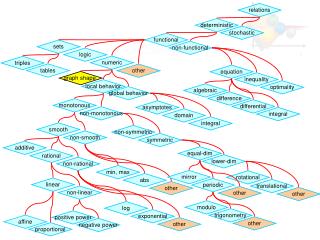
Toexpress criteria, usepenalties. Variationstopenalties (y = f(cat.-I quantities)): q = y: y shouldbe small; assumethat y0 q = |y| or q=y2: y shouldbe small in absolute value q = |max(y,y0)-y0|: y shouldbe smaller than y0 q = |y0-min(y,y0)|: y shouldbelargerthan y0 q = |y-y0|: y shouldbe close to y0 q = 1/|y| or q = 1/(w+|y|), w>0: y shouldbe large et cetera (usefunctionselector or imagination!) http://commons.wikimedia.org/wiki/File:Big_and_small_dog.jpg
Summary: formulateproblem in terms of criteria criteria correspondto cat.-II quantities considerexpressing criteria as penalties: quantities q, q0,thatshouldbe small as possible choose criteria suchthat non-trivialproblemresults multiple criteria: consideraddingpenalties Q=iwiqiwith proper weightswi, wi>0 form expressions with |...|, max(...) etc. toexpress right type of criterion