Download

1 / 5
50 likes | 166 Vues
This draft highlights the advantages of using Explicit Congestion Notification (ECN) in network traffic management, including less obvious benefits and deployment scenarios. It identifies potential pitfalls such as policies affecting deployment, middlebox requirements, and issues with ECN codepoint handling. The conclusion emphasizes the importance of configuring host stacks and network devices properly to support ECN without disruption. The draft aims for Working Group Last Call (WGLC) at the next IETF meeting, inviting further contributions and comments on deployment use cases.

E N D
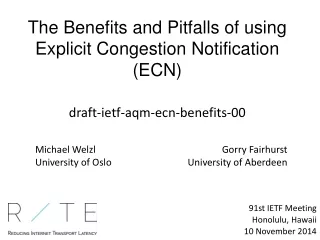
The Benefits and Pitfalls of using Explicit Congestion Notification (ECN)draft-ietf-aqm-ecn-benefits-00 Michael WelzlUniversity of Oslo Gorry FairhurstUniversity of Aberdeen 91st IETF Meeting Honolulu, Hawaii10 November 2014
Draft goals • Point of draft: • document gains of ECN • includes less obvious gains • Could include deployment scenarios to illustrate benefit • NEW: now also “pitfalls” (next slide) • Out of scope: • To recommend a specific behavior
Pitfalls • Policies that bleach and middlebox requirements to deploy • Also points to RFC6040 for correct use of tunnelling • Cheating by hosts • Possible need for mechanisms to verify if a path really supports ECN
New conclusion(not “turn it on”, but “don’t break it”) • People configuring host stacks and network devices should ensure that their equipment correctly reacts to packets carrying ECN codepoints. • This includes: • routers not resetting the ECN codepoint to zero • middleboxes not resetting the ECN codepoint to zero • correctly updating the codepoint when congested • routers correctly supporting alternate ECN semantics ([RFC4774]) • hosts receiving ECN marks correctly reflecting them
Next Steps • Aim to WGLC after next (Dallas) IETF! • Deployment scenarios / use cases still pretty empty • This section could be small • Text donations welcome • Other comments?