Design and Synthesis of Novel Pyrene Discotics for Organic Photovoltaic Applications
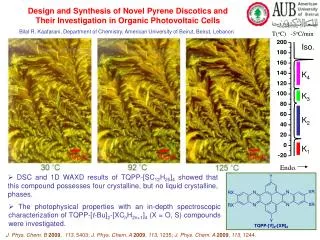
This study focuses on the design and synthesis of novel pyrene discotic molecules, specifically TQPP-[SC12H25]4 and TQPP-[t-Bu]2-[XCnH2n+1]4 (X = O, S). The thermal analysis through differential scanning calorimetry (DSC) and one-dimensional wide-angle X-ray diffraction (1D WAXD) revealed that TQPP-[SC12H25]4 exhibits four crystalline phases without liquid crystallinity. The research further explores the photophysical properties and detailed spectroscopic characterization, providing insights into their potential applications in organic photovoltaic cells.

Design and Synthesis of Novel Pyrene Discotics for Organic Photovoltaic Applications
E N D
Presentation Transcript
-5oC/min T(oC) Iso. K4 K3 K2 K1 Endo. Design and Synthesis of Novel Pyrene Discotics and Their Investigation in Organic Photovoltaic Cells Bilal R. Kaafarani, Department of Chemistry, American University of Beirut, Beirut, Lebanon K2 Phase K3 Phase K4 Phase DSC and 1D WAXD results of TQPP-[SC12H25]4 showed that this compound possesses four crystalline, but no liquid crystalline, phases. The photophysical properties with an in-depth spectroscopic characterization of TQPP-[t-Bu]2-[XCnH2n+1]4 (X = O, S) compounds were investigated. J. Phys. Chem. B 2009, 113, 5403; J. Phys. Chem. A 2009, 113, 1235; J. Phys. Chem. A 2009, 113, 1244.