Download
1 / 27
270 likes | 362 Vues
This review covers the basics of the Scientific Method, measurements, gas laws, atoms, and bonding in science. Learn key concepts and definitions to enhance your understanding of scientific principles.

E N D
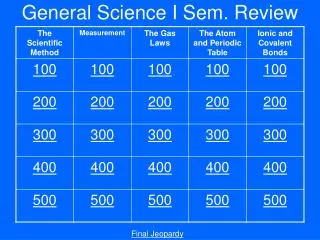
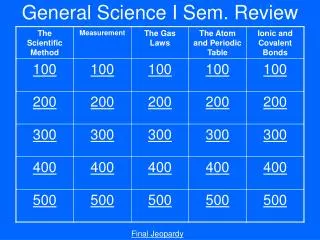
General Science I Sem. Review Final Jeopardy
The Scientific Method 100 • Define hypothesis. • A testable statement. • Ex) If you wear high heels instead of running shoes, then you won’t run as far. Back
The Scientific Method 200 • Define observation. • A statement made using the senses. • Ex) The flame is blue and 700oC Back
The Scientific Method 300 • What is the difference between a qualitative observation and a quantitative observation? • Qualitative- qualities of the object • Quantitative- quantities/numbers of the object Back
The Scientific Method 400 • Is the following a qualitative or a quantitative observation:There are 82 paper clips on the ground. • Quantitative- there was a quantity or numbers involved. Back
The Scientific Method 500 • In an experiment, you control things and you vary things. Define control and variable. • Control- everything you keep the same in the experiment. • Variable- the ONE thing you change in the experiment. Back
Measurement 100 • What is each letters’ metric prefix? K H D _ d c m • Kilo- ; Hecto- ; Deka- ; _ ; deci- ; centi-; milli-; Back
Measurement 200 • DAILY DOUBLE!!!! • Convert 50cm to m. • KHD_dcm m is in the middle… 0.5 m Back
Measurement 300 • What is the unit for temperature in science? • Celsius Back
Measurement 400 • Define mass. • The amount of matter in an object. Back
Measurement 500 • Define volume. • How much space an object takes up. Back
The Gas Laws 100 • Define diffusion. • When particles move from an area of high concentration to low concentration. Back
The Gas Laws 200 • State Boyle’s Law • “Boyle is at PV” • As pressure goes up, volume goes down. They’re opposites. Back
The Gas Laws 300 • State Charles’ Law • “Charles had a TV” • As temperature goes up, volume goes up. They do the same thing. Back
The Gas Laws 400 • Boyle’s Law or Charles’ Law?A hot-air balloon • Charles law (increase T of air in the balloon, it inflates; hot air rises, so balloon goes up in the air. Cool it down, it slowly sinks) Back
The Gas Laws 500 • Charles Law or Boyles’s Law?A bicycle pump • Boyles’s (Decrease the volume of the launcher and pressure builds up, shooting the potato) Back
The Atom/PT 100 • Atomic number = Atomic mass - what? • Atomic number = Atomic mass - NEUTRONS. Back
The Atom/PT 200 • What is an isotope? • An atom with a different number of neutrons. Back
The Atom/PT 300 • Rows on the PT are called _______ and columns are called ___________. • Rows are “periods” and columns are “families” or “groups” Back
The Atom/PT 400 • What goes is the blank with the “?” • 56; Atomic # and Proton # are equal Back
The Atom/PT 500 • The most reactive metal is ______. • Francium, sodium, or potassium? • Francium Back
Ionic and Covalent Bonds 100 • Ionic bonds _______ (share/transfer) electrons and bond with a _______ (metal/nonmetal) and a _____ (metal/nonmetal) • Transfer electrons and bond with a metal and a nonmetal Back
Ionic and Covalent Bonds 200 • Covalent bonds form between a _____ (metal/nonmetal) and a ____ (metal/nonmetal) • Covalent bonds always form between two nonmetals Back
Ionic and Covalent Bonds 300 • Write the formula for Sodium bromide. Is this an ionic or covalent bond? • NaBr… ionic Back
Ionic and Covalent Bonds 400 • Write the formula for dicarbon hexahydride; is this ionic or covalent • di=2; hexa=6; C2H6 prefixes mean covalent bond Back
Ionic and Covalent Bonds 500 • List one property of ionic compounds and one property of covalent compounds. • Ionic: high melting point, conduct electricity, brittleCovalent: low melting point, poor conductors of electricity Back
Final Jeopardy • Chemical ReactionsMAKE YOUR WAGER! • Cl2 + 4 NaBr 2 NaCl+ 2 Br2 Balanced? No Back