Download
1 / 3
40 likes | 173 Vues
This lesson covers essential vocabulary related to "statue," "stature," and "statute," providing clear definitions and differences. Additionally, it explores the future tense, highlighting its formation with the helping verbs "shall" or "will." Guidelines for using "shall" in formal versus informal writing are discussed, alongside common errors to avoid, such as mistakenly using the present tense instead of the future tense. Enhance your grasp on these concepts for better writing and understanding.

E N D
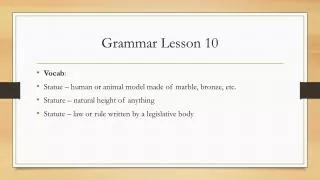
Grammar Lesson 10 • Vocab: • Statue – human or animal model made of marble, bronze, etc. • Stature – natural height of anything • Statute – law or rule written by a legislative body
Future Tense • Future tense – used to show that action has not occurred • Formed with the helping verbs shall or will • With pronouns I and we, using shall is preferred in formal writing. • In informal writing, shall is sometimes used with other pronouns to show strong emotion, imply a threat, or imply a command
Errors to avoid • Do not use present tense for future tense